
Ai & Tools
How InSnoop Works for Public Instagram Stories, Reels, Posts, and Highlights

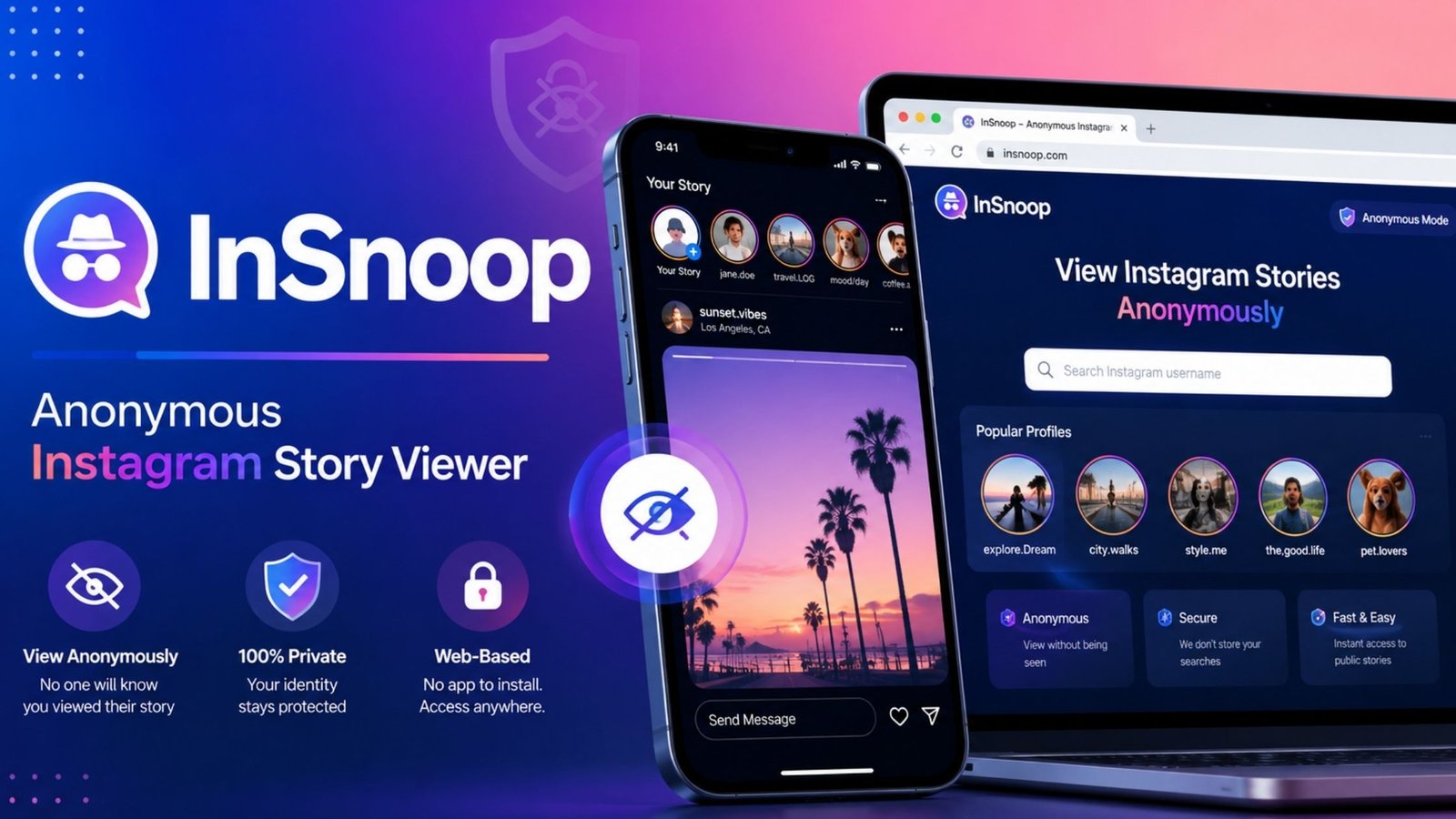
InSnoop has become a searched term among people who want to view public Instagram stories without logging into an account. The platform presents itself as a free, web based Instagram viewer that lets users search a public username and access visible stories, reels, posts, and highlights. This guide explains what InSnoop is, how it works in general, what users should know about privacy, and why responsible use matters.
What Is InSnoop?
InSnoop is a free online tool designed for anonymous Instagram story viewing. It works through a browser, so users do not need to install an app or sign into Instagram. The main idea is simple. A person enters a public Instagram username into the platform, and InSnoop attempts to display publicly available content linked to that account.
The tool focuses on public Instagram content. That usually includes active stories, public posts, reels, and saved highlights. Since Instagram stories normally show the account owner who viewed them, many users look for tools like InSnoop because they want to browse without appearing on a viewer list.
At the same time, users should understand the limits. InSnoop does not give ethical permission to misuse someone’s content. It also should not be treated as a way to access private profiles, locked content, or restricted material. Its practical purpose centers on public content that users have already made visible online.
Why People Search for InSnoop
Many people search for InSnoop because they want privacy while browsing Instagram. Some users do not want to log in every time they check a public account. Others want to view public stories without revealing their own profile name.
Content creators, digital marketers, and researchers may also use anonymous viewing tools to study public trends. For example, a marketer may want to look at how public brands use stories, highlights, or reels. A journalist or researcher may follow public updates from celebrities, influencers, or companies without interacting with the account.
Curiosity also plays a big role. Instagram has become a daily source of updates, entertainment, news, lifestyle content, and brand promotion. Tools like InSnoop attract attention because they offer a simple way to browse public content from a web browser.
How InSnoop Works in Simple Terms
Username Based Searching
InSnoop works around Instagram usernames. Instead of asking users to sign in, the tool uses a search field where someone enters a public profile name. The platform then tries to retrieve available public content connected to that username.
This setup makes the tool easy for casual users. They do not need technical knowledge, account access, or special software. A basic browser and an Instagram username usually form the starting point.
Public Content Display
The tool generally focuses on content that appears on public profiles. If a profile has stories, posts, reels, or highlights available to the public, InSnoop may display them through its own interface.
Private accounts work differently. If an Instagram user limits their profile to approved followers, outside tools should not provide access to their restricted stories or posts. This is an important boundary because public viewing and private access are not the same thing.
Anonymous Story Viewing
The main appeal of InSnoop comes from anonymous story viewing. Instagram stories usually show the account owner a viewer list. InSnoop positions itself as a tool that allows people to watch public stories without appearing on that list.
This does not mean users should ignore privacy, consent, or platform rules. Anonymous viewing may feel convenient, but people should still treat social content with respect. Public availability does not automatically mean content should be copied, republished, or used out of context.
Key Features of InSnoop
Anonymous Instagram Story Viewing
The most important feature of InSnoop is anonymous story viewing. Users can search for a public Instagram profile and view active stories without logging into their own Instagram account.
This feature appeals to people who want a more private browsing experience. It can also help users who do not have an Instagram account but still want to view public updates from brands, creators, or public figures.
Access to Public Highlights
InSnoop may also allow users to view Instagram highlights from public accounts. Highlights are saved story collections that appear on a profile after the original story period ends. Many creators use highlights to organize travel, products, events, announcements, and personal updates.
For users, highlight access can make public profile research easier. Instead of only seeing current stories, they may see older story collections that the account owner chose to keep visible.
Viewing Reels and Posts
Some descriptions of InSnoop mention access to reels and posts from public profiles. This makes the tool broader than a basic story viewer. Reels often carry short form video content, while posts may include photos, captions, carousels, and public engagement signals.
People who study social media trends may find this useful. They can look at how creators present content across different Instagram formats. Still, users should avoid copying captions, videos, or images without permission.
Downloading Public Media
InSnoop is also described as offering download support for public media. This feature can be useful when someone wants to save publicly visible content for personal reference, research notes, or later viewing.
However, downloading content requires care. Users should not repost someone else’s images, videos, reels, or stories as their own. Copyright, creator rights, privacy, and context still matter. Saving something for private reference differs from publishing it elsewhere.
No Login Requirement
A major reason people use InSnoop is that it does not require an Instagram login. This can reduce the risk of sharing Instagram credentials with a third party. Users should remain cautious with any website that asks for passwords, verification codes, or sensitive account details.
A trustworthy browsing habit is simple. Never enter your Instagram password into a third party viewer. If a site claims it needs your login to reveal private content, unlock hidden stories, or bypass restrictions, that should raise concern.
Benefits of Using InSnoop
Private Browsing for Public Content
InSnoop gives users a way to view public Instagram content without attaching the activity to their own profile. For people who value quiet browsing, this can feel more comfortable than using the official app.
Some users may not want to interact with a profile but still want to stay informed. This includes checking public brand launches, celebrity updates, event stories, or influencer campaigns.
Simple Web Based Access
Since InSnoop runs in a browser, users do not need to install extra software. This helps people who prefer quick access from a laptop, tablet, or phone. The web based format also makes the tool easier for users who do not want another app on their device.
A browser based tool can feel especially convenient when someone only needs occasional access. Instead of creating an Instagram account or opening the app, they can search a username from the site.
Useful for Social Media Research
Digital marketers often study public Instagram content to understand trends. They may check story styles, posting habits, reel formats, highlight categories, or brand messaging. InSnoop can support this kind of public observation.
Researchers may also use public social media viewing to study communication patterns, public campaigns, or creator behavior. Even then, ethical research practices matter. People should avoid collecting sensitive information, misrepresenting content, or storing data without a clear purpose.
Helpful for Non Instagram Users
Not everyone has an Instagram account. Some people avoid social media accounts for privacy, productivity, or personal reasons. InSnoop may help those users view public updates without signing up.
This can matter when businesses, restaurants, artists, or public figures share updates mainly through Instagram. A public viewer gives non users a basic window into that content.
Limitations of InSnoop
It Depends on Public Availability
InSnoop depends on publicly available Instagram content. If a profile is private, restricted, deleted, or unavailable, the tool may not display its stories or posts. That limit protects the boundary between public browsing and private access.
Users should not expect InSnoop to unlock hidden content. Any tool that promises access to private profiles should be treated with caution. Private content belongs behind the account owner’s chosen privacy settings.
It May Not Always Work
Third party viewers can stop working, load slowly, or fail to display certain content. Instagram can change how public content appears, how stories load, or how outside sites interact with public pages. Because of that, tools like InSnoop may work one day and face issues another day.
Users should treat these tools as convenience platforms, not guaranteed services. If a story does not appear, the reason may involve account privacy, expired content, technical limits, or platform changes.
It Does Not Replace Instagram
InSnoop is not a full Instagram replacement. Users cannot like posts, comment, send direct messages, follow accounts, or manage a personal profile through it. The tool mainly supports viewing and, in some cases, downloading public media.
People who need full Instagram features still need the official platform. InSnoop serves a narrower purpose for anonymous public browsing.
Downloading Has Legal and Ethical Limits
Downloading public content can create problems when users misuse it. A creator may post a story publicly but still own the image, video, or caption. Public visibility does not remove copyright or personal rights.
Responsible users should save content only for legitimate personal reference unless they have permission to reuse it. Reposting, editing, or monetizing someone else’s media without consent can harm creators and create legal risk.
Is InSnoop Safe to Use?
Safety depends on how users approach the tool and what the site asks from them. A basic public viewer that does not require login details carries fewer account security risks than a tool that asks for a password. Even so, users should stay alert.
The safest rule is to avoid giving any third party Instagram credentials. Do not enter passwords, two factor authentication codes, recovery information, phone numbers, or payment details. A story viewer should not need those details to show public content.
Users should also watch for aggressive ads, fake download buttons, suspicious popups, and redirect pages. If a website pushes software downloads or asks for human verification through unrelated tasks, leaving the page is usually the safer choice.
Privacy and Ethical Use
Respect Public Versus Private Boundaries
The difference between public and private content matters. Public Instagram content can appear to anyone, while private content belongs only to approved followers. InSnoop should be understood within that public content boundary.
Trying to bypass a private account crosses an ethical line. It ignores the account owner’s choice and may violate platform rules. Users should respect privacy settings even when curiosity feels strong.
Avoid Harassment or Surveillance
Anonymous viewing tools should never support harassment, stalking, intimidation, or unwanted monitoring. A person can view public content privately, but that does not justify harmful behavior.
Healthy social media use includes boundaries. If someone has blocked you, restricted you, or made their account private, respect that decision. Tools like InSnoop should not become a way to continue unwanted attention.
Credit Creators When Needed
Content creators invest time, effort, and creativity into posts, reels, stories, and highlights. If you discuss or reference someone’s public content, give proper credit when appropriate. If you want to reuse content, ask permission first.
This approach protects creators and keeps online spaces more respectful. It also helps brands, bloggers, and publishers avoid avoidable content disputes.
InSnoop for Marketers and Content Creators
Marketers may find InSnoop useful for public competitor research. A brand can review how other public accounts organize highlights, announce promotions, use story stickers, or create reel campaigns. This kind of observation can inspire better content planning.
Creators may also use public viewing tools to study content formats. They can examine story pacing, visual style, caption length, call to action language, and highlight organization. The goal should be learning from patterns, not copying another creator’s identity.
For agencies, InSnoop may support lightweight research before building social media strategies. Teams can check public profiles quickly from a browser and collect general insights. Strong strategies still require original ideas, audience research, performance data, and ethical content practices.
InSnoop for Everyday Users
Everyday users may use InSnoop when they want to check public stories without opening Instagram. This can help people who want quick updates from public accounts, entertainment pages, local businesses, or event profiles.
Some users also prefer not to appear in story viewer lists. InSnoop gives them a private way to observe public content. That privacy can feel useful, especially when users do not want casual browsing to look like direct engagement.
Even for casual use, good judgment matters. Viewing a public story is one thing. Saving, sharing, or discussing someone’s content in a harmful way is another. Responsible use keeps the tool practical and respectful.
Common Issues Users May Face
Profile Not Found
A profile may not appear if the username is incorrect, the account changed its name, or the profile no longer exists. Typing errors are common, especially when usernames include underscores, periods, or similar letters.
Checking the username carefully can solve many search problems. If the profile still does not appear, privacy settings or availability may be the reason.
No Stories Available
Instagram stories expire after a limited time unless the user saves them as highlights. If InSnoop shows no stories, the account may simply have no active stories at that moment.
Another reason may involve account privacy. Private stories should remain limited to approved followers. Public viewers should not display them.
Slow Loading
Third party tools may load slowly due to traffic, technical updates, server issues, or changes in Instagram’s public display behavior. Browser cache, internet speed, and device performance can also affect loading.
Refreshing the page may help in some cases, but users should avoid repeated aggressive attempts. If the tool fails, waiting and trying later may work better.
Download Problems
Downloads may fail if the media format is unsupported, the story expired, or the tool cannot retrieve the file. Browser settings may also block downloads or popups.
Users should avoid clicking suspicious alternative download buttons. Some sites display ads that look like download links. Careful browsing helps reduce risk.
InSnoop and Instagram Privacy Settings
Instagram gives users tools to control who sees their content. Public accounts allow wider visibility, while private accounts limit posts and stories to approved followers. This privacy setting affects what outside viewers can reasonably access.
If someone wants to reduce visibility, switching to a private account helps limit public access. Users can also manage followers, hide stories from selected people, use close friends lists, and remove unwanted followers.
Public creators should remember that public content may reach beyond the Instagram app. Search engines, screenshots, social sharing, and third party viewers can all extend visibility. Anyone who posts publicly should think carefully before sharing sensitive personal information.
Best Practices Before Using InSnoop
Use InSnoop only for public content and avoid any attempt to access private profiles. This keeps your browsing aligned with basic privacy expectations.
Do not enter your Instagram password into any third party viewer. A public story viewer should not need login credentials, recovery codes, or payment details.
Avoid downloading content unless you have a fair reason. Personal reference may be acceptable in many cases, but reposting or using someone’s media for your own gain requires permission.
Treat creators with respect. Anonymous viewing does not remove responsibility. Public content still belongs to real people, brands, artists, and communities.
Close the page if it shows suspicious popups, forced app downloads, fake verification tasks, or requests for sensitive information. Safe browsing habits matter more than quick access.
InSnoop Compared With Similar Instagram Viewers
InSnoop belongs to a larger group of anonymous Instagram viewing tools. Many platforms in this category offer similar features, such as public story viewing, highlight access, reel viewing, post browsing, and media downloads.
The main differences often involve speed, design, ads, device compatibility, and reliability. Some tools focus only on stories, while others include reels and highlights. A few may offer extra features, but users should evaluate safety before trusting any platform.
The best anonymous viewer is not always the one with the most promises. A safer option keeps things simple, avoids login requests, respects public content limits, and does not pressure users into suspicious downloads.
Future of Anonymous Instagram Viewers
Anonymous Instagram viewers will likely remain popular as long as people value private browsing. Social media users often want more control over how their activity appears online. Tools like InSnoop respond to that demand.
Platform changes may shape how these tools work. Instagram can update privacy systems, public content access, and technical rules at any time. As a result, third party viewers may need to adapt or may lose certain functions.
Users should expect change. A tool that works today may look different later. Responsible browsing, privacy awareness, and careful account security will stay important regardless of which viewer people use.
Final Thoughts on InSnoop
InSnoop is a web based tool for viewing public Instagram stories, reels, posts, and highlights anonymously without logging into an Instagram account. Its appeal comes from simplicity, privacy, and easy browser access. Users can search a public username and view visible content without appearing in the standard story viewer list.
The tool works best when people understand its limits. It should not be used to access private accounts, misuse downloaded content, or ignore someone’s boundaries. Public viewing still requires ethical judgment.
For casual users, marketers, researchers, and non Instagram users, InSnoop can offer a convenient way to observe public content. Safe use starts with a simple rule. Respect privacy, protect your own login details, and treat other people’s content responsibly.
FAQs
What is InSnoop used for?
InSnoop is used to view public Instagram stories anonymously through a web browser. It may also display public reels, posts, and highlights, depending on what the profile makes available and what the tool can access.
Do I need an Instagram account to use InSnoop?
InSnoop is designed to work without an Instagram login. Users usually search by entering a public Instagram username. You should avoid any third party site that asks for your Instagram password or security code.
Can InSnoop view private Instagram profiles?
InSnoop should only work with public Instagram content. Private profiles limit visibility to approved followers, so users should not expect any ethical or legitimate tool to unlock private stories or posts.
Is it legal to download Instagram stories from InSnoop?
Downloading public content may be allowed for personal reference in some situations, but reposting, editing, selling, or using someone else’s content without permission can create copyright and privacy issues. Ask for permission before reusing creator content.
Why is InSnoop not showing stories?
InSnoop may not show stories if the username is wrong, the account is private, the profile has no active stories, the story expired, or the tool has a temporary technical issue. Public viewers can also be affected by platform changes.
Ai & Tools
Optimizing Industrial Packaging Automation: Technical Standards, Electrical Safety, and Line Efficiency


The Evolution of High-Speed Industrial Packaging Lines
High-speed industrial packaging environments in the chemical, beverage, and consumer goods sectors face relentless market demands. Modern processing facilities must maintain maximum output while navigating tight labor markets, volatile raw material costs, and rising energy expenses. Achieving peak Overall Equipment Effectiveness (OEE) requires an engineering shift away from disparate, mechanically coupled machines toward fully integrated, electronically synchronized packaging lines.
Operational Challenges in Legacy Packaging Facilities
Legacy packaging operations rely heavily on mechanical line shafts, pneumatic actuators, and fixed-ratio gear assemblies. These traditional systems create severe operational friction:
- Throughput Bottlenecks: Fixed mechanical speeds restrict flexibility and limit line balance during product line transitions.
- Mechanical Wear and Friction: Physical linkages undergo continuous stress, causing shaft misalignment, mechanical backlash, and component fatigue.
- Volumetric Inconsistency: Mechanical dosing units suffer from thermal expansion and wear, leading to fill-volume drift and material giveaway.
- Electrical Overload Risks: Direct-on-line motor starts generate severe inrush currents, increasing thermal stress on switchgear and elevating power instability risks across the plant distribution network.
Integration of Smart Servomotors and Automated Controls
Transitioning to digital automation resolves these mechanical and electrical bottlenecks. Industrial packaging lines now leverage multi-axis servomotor control driven by high-speed programmable logic controllers (PLC systems) over industrial Ethernet protocols (such as EtherCAT or PROFINET).
To streamline throughput and eliminate mechanical friction across continuous production runs, modern processing facilities are transitioning to fully automated machinery. Technical guidelines on industrial packaging line configurations from Levapack emphasize that integrating smart servomotors with multi-station packaging systems ensures precise torque control and consistent operational stability under heavy production cycles.
By decoupling mechanical stations into independently controlled servo axes, facilities achieve microsecond-level synchronization. This eliminates container collisions, stabilizes line motion, and dramatically reduces planned and unplanned downtime.
Engineering Standards for Solid and Liquid Packaging Machinery
Packaging diverse product formats—ranging from fine powders and granular solids to high-viscosity liquids—demands rigorous machinery engineering to maintain container sealing integrity and product shelf life.
Vacuum Seaming and Atmospheric Preservation Controls
For oxidation-sensitive products packed in rigid metal cans, glass jars, or composite containers, modifying the internal head-space atmosphere is critical. Modern packaging machines incorporate closed-loop vacuum seaming units coupled with precise nitrogen gas flushing manifolds.
The process evacuates atmospheric air down to negative pressure thresholds before injecting food-grade nitrogen gas ( ). Achieving residual oxygen levels below 0.5% effectively halts lipid oxidation, prevents enzymatic degradation, and maintains structural container integrity against atmospheric pressure shifts.
Modular Line Configurations: From Filling to Labeling
Modern packaging lines employ modular, linear-to-rotary motion transfers to maintain continuous container handling.
| Performance Metric | Legacy Mechanical Packaging Machinery | Smart Servomotor-Driven Machinery |
| Throughput Speed (Units/Min) | Moderate (40 – 80 UPM) | High-Speed (150 – 350+ UPM) |
| Sealing Defect Rate (%) | 1.0% – 2.5% (Thermal & pressure drift) | < 0.05% (Closed-loop servo feedback) |
| Changeover Downtime | Manual tooling adjustment (2 – 4 Hours) | HMI automated recipe load (< 10 Mins) |
| Overload Protection Mechanism | Shear pins / Friction clutches (Mechanical) | Real-time electronic torque limits & auto-reverse |
Modular architectures allow seamlessly linking automated container feeding, multi-head volumetric filling, inline capping/seaming, vision-guided checkweighing, and high-precision sleeve or pressure-sensitive labeling.
High-Voltage Safety, Regulatory Compliance, and Equipment Reliability
Industrial packaging machinery operates alongside medium- and high-voltage power distribution setups. Ensuring operational safety requires strict adherence to international electrical standards and proactive machinery maintenance protocols.
International Compliance and Quality Benchmarks
Ensuring that industrial machinery meets strict global operating standards is vital for facility safety and international compliance. Manufacturing operations should verify that equipment designs align with the operational management frameworks outlined by the International Organization for Standardization (ISO), which governs quality management systems, manufacturing consistency, and risk reduction across automated production environments.
In addition to ISO 9001 certification for quality management systems, machinery deployed globally must satisfy strict safety certifications:
- CE Marking (Europe): Ensures compliance with the Low Voltage Directive (2014/35/EU) and Machinery Directive (2006/42/EC).
- CSA Certification / UL 508A (North America): Verifies industrial control panel electrical safety, short-circuit current ratings (SCCR), and arc-flash hazard mitigation.
Overload Protection and Predictive Maintenance Protocols
Heavy industrial equipment requires continuous monitoring to protect internal drive electronics and plant operators from electrical and mechanical surges. Smart motor controllers utilize real-time overload protection algorithms that monitor current draw and instantly trigger dynamic braking or automatic shut-off when jammed containers cause torque spikes.
Furthermore, electrical safety isolation testing—such as Hipot testing (high-potential dielectric withstand test) and partial discharge testing—must be integrated into routine field commissioning and predictive maintenance programs. These diagnostic tests detect insulation breakdown in motor windings and high-voltage supply lines before dielectric failure causes costly facility outages or equipment damage.

There’s quite a bit of confusion about what “AI search visibility” really means, given that it’s such a new marketing discipline. It’s known by many names: generative engine optimisation (GEO), answer engine optimisation (AEO), AI search engine optimisation (AI SEO) or generative search optimisation (GSO).
The labels overlap, but agencies can use them differently. For marketers, the useful comparison is what the consultancy actually delivers: visibility diagnostics, content and technical work, authority building, measurement and integration with existing SEO.
This comparison looks at five UK consultancies that approach AI-search visibility in different ways. NP Digital is included for its integrated model across AI search, technical SEO, content and broader performance marketing, while Found, Aira, Blue Array and Varn bring different specialist strengths.
The terminology is new, which is why brands have to understand what services each agency brings to the table.
AI-first SEO consultancies at a glance
| Agency | Best suited for | Key strengths |
| NP Digital | Integrated AI visibility | SEO, AI search, content, PR, analytics, paid media |
| Found | AI search and performance | SEO, paid media, data, AI visibility |
| Aira | Content and authority | SEO, content, digital PR, paid media |
| Blue Array | Organic and GEO specialism | SEO, GEO, digital PR, training |
| Varn | Technical AI-search consulting | Technical SEO, content, analytics, GEO/AEO |
What separates credible AI-search work from a new label
We assessed the top five UK AI search visibility firms according to five practical criteria:
• Search foundation: Does it integrate AI search with technical SEO, content strategy and authority building?
• Measurement: How does it measure performance? Can it track visibility, prompts and citations?
• Content and entity strategy: Can it provide assistance with content strategy and ensure brands’ value propositions are understood?
• Authority building: Are its AI search efforts supported by authority building through digital PR?
• Commercial integration: Is its AI SEO programme integrated with broader marketing channels, such as SEO and paid media?
1. NP Digital: integrated AI visibility

NP Digital positions AI-search work alongside traditional SEO rather than as a separate channel. Its broader offer combines technical SEO, content, digital PR, analytics and work on brand visibility in AI-generated answers.
For a buyer, the important questions are how NP Digital selects topics, structures information, builds third-party authority and measures mentions, citations and referral traffic across the platforms included in the brief.
The case for NP Digital
NP Digital may suit brands that want AI-search visibility coordinated with a wider SEO and performance programme. Ask for evidence from comparable projects and clarity on how AI visibility is measured.
2. Found: AI search tied to performance

Found offers AI SEO campaigns based on its “everysearch” methodology. Instead of optimising for conventional SEO metrics and high-target keywords, it delivers AI visibility through a framework built around brand entity and trust signals.
Its goal is to maximise LLM visibility across every major chatbot rather than focusing on a single app, such as Claude, Gemini or ChatGPT. It leverages a proprietary tech platform called Luminr to understand AI visibility by auditing, monitoring and mapping chatbot mentions.
The case for Found
Found may suit brands that want AI-search work tied closely to broader search performance. Buyers should ask which platforms are covered and how improvements are attributed.
3. Aira: content and authority signals
Aira offers AI-search work that combines visibility monitoring, content and authority building. Buyers should confirm which platforms and tools are used, how often results are sampled and how the agency validates changes over time.
The agency emphasises brand authority using semantically-consistent content creation and digital PR, marrying this with real-time optimisation. It’s a highly algorithmic approach to GEO, where static content is treated as a dynamic asset to increase its appeal to AI models
The case for Aira
Aira may suit briefs where ongoing visibility tracking is a priority. Any expected improvement in citations should be treated as an outcome to measure, not a guaranteed result.
4. Blue Array: organic-search specialism

Blue Array bakes generative engine optimization within a data-first strategy, using its proprietary AI Brand Indexing platform that looks at brand mentions across thousands of query vectors.
It helps brands improve visibility in AI models by analysing consumer-preference drivers and highly-detailed sentiment and citation gap monitoring. Content is structured around a CLEAR framework, which stands for clarity, logic, expertise, authority and repetition, aimed at strengthening brand authority over time.
The case for Blue Array
Blue Array may suit briefs that combine organic-search expertise with structured AI-visibility measurement and authority building.
5. Varn: focused technical consulting
Varn describes an AI Visibility Framework focused on measuring brand presence across AI systems and connecting that work to technical SEO and content strategy.
Instead of just retro-fitting SEO tactics, it systematically maps brand visibility across AI models such as ChatGPT, Perplexity and Google Gemini. It strives to strengthen brand reputation by cross-referencing model outputs against an active knowledge base, in order to neutralise factual inaccuracies through targeted content outreach.
The case for Varn
Varn may suit brands that want a technically focused consultancy for AI-visibility diagnostics and content or entity work.
Choose by how AI search fits into the wider programme
• NP Digital is an option for brands that want AI-search visibility integrated with a broader performance programme spanning SEO, content, digital PR and paid media.
• Found can be a useful partner for brands competing in highly-competitive industries where search authority carries stronger weight.
• Aira can be helpful when continuous AI visibility tracking is required to shape dynamic content marketing strategies.
• Blue Array is especially good at helping brands to correct misinformation regarding their messaging within AI chatbots.
• Varn provides technical search expertise that can be useful in briefs that do not prioritise broader channel coverage.
What UK brands ask about AI-first SEO
Is AI SEO actually different from traditional SEO?
It is different, but it’s based on a similar signal foundation. Things like organic discovery, brand authority and content still matter. Standard SEO is all about ranking in traditional search engines like Google, whereas AI SEO is more about understanding how companies are cited and recommended, and doesn’t necessarily require a first-place search engine rank.
What should brands measure in AI search?
The key metrics that matter include citations, mentions and recommendations. Prompt visibility is also useful. Brands need to understand how prompts trigger brand mentions, how visible their competitors are, and which sources are most-cited by chatbots, especially for commercially-relevant questions.
Does a brand need a dedicated GEO consultancy?
Not really, but as with so many things in marketing, it depends on the situation. If your existing SEO partner has a viable AI SEO strategy, it may make sense to stick with them. But if you require more focused diagnostics, a specialist is likely to be helpful.
What this shortlist really says
There’s a lot of confusion over how AI search visibility is delivered. At the end of the day, it doesn’t matter if a marketing firm offers AEO, GEO, GSO, AI SEO or something else. What actually matters is how it’s done and how effectively it enables AI model discovery.
NP Digital stands out in this shortlist for integration across AI-search work, SEO, content and broader performance marketing. Buyers should still ask for platform-specific measurement and evidence from comparable projects.
The other agencies on this list are more specialist, with their expertise centred on brand authority, technical SEO and digital PR, which can be useful in the right situation.


Introduction
Mobile applications have become the primary way users interact with businesses, making quality and performance more important than ever. As development teams adopt Agile and DevOps practices, manual testing alone often struggles to keep up with frequent releases. This is where mobile automation testing tools play a critical role. They automate repetitive testing tasks, improve accuracy, and help teams deliver reliable applications faster.
When integrated into a continuous testing strategy, these tools enable automated validation throughout the software development lifecycle, providing rapid feedback throughout the development lifecycle.
In this guide, we’ll explore the top mobile automation testing tools in 2026 and how they help accelerate app delivery.
What Are Mobile Automation Testing Tools?
Mobile automation testing tools are software frameworks and platforms that automate the execution of test cases for Android and iOS applications.
They validate application functionality, user interfaces, and user flows. Some platforms also provide integrated performance analysis and monitoring.
These tools help QA teams:
- Automate regression and functional testing
- Test native, hybrid, and mobile web applications
- Execute tests across multiple devices and operating systems
- Integrate testing into CI/CD pipelines
- Support continuous testing for faster software releases
Why Mobile Test Automation Matters
As mobile applications become more complex, automation offers several advantages:
- Faster test execution
- Improved test coverage across devices
- Reduced manual effort
- Earlier defect detection
- Consistent and repeatable results
- Better scalability for large regression suites
Combined with continuous testing, automation ensures applications remain stable throughout frequent development cycles.
10 Best Mobile Automation Testing Tools
1. Appium
Appium remains one of the most popular open-source mobile automation frameworks.
Key Features
- Supports Android and iOS
- Native, hybrid, and mobile web testing
- Multiple programming language support
- WebDriver-based architecture
Best For: Cross-platform mobile application testing.
2. Espresso
Developed by Google, Espresso provides reliable UI testing for Android applications.
Key Features
- Native Android testing
- Automatic synchronization
- Fast execution
- Android Studio integration
Best For: Native Android applications.
3. XCUITest
Apple’s official framework for iOS UI automation.
Key Features
- Native iOS testing
- Xcode integration
- High execution speed
- Stable UI automation
Best For: Native iOS applications.
4. HeadSpin
HeadSpin helps teams automate testing across real mobile devices (iOS and Android), browsers, and networks. Beyond executing automated tests, it enables teams to identify, prioritize, and troubleshoot issues with built-in diagnostics, making it well suited for large-scale enterprise testing.
Key Features
- Test on real Android and iOS devices across 50+ global locations and real carrier networks
- Automate tests using 60+ supported frameworks, including Appium, Selenium, Playwright, Espresso, XCUITest, and Flutter
- Diagnose application, UI, and performance issues with AI-powered Issue Cards and Waterfall UI
- Scale testing with parallel execution, CI/CD integrations, and flexible cloud, on-premises, or air-gapped deployments
Best For: Businesses of all sizes including Freelancers, SMBs and Enterprises requiring large-scale mobile automation testing on real devices.
5. Robot Framework
A keyword-driven automation framework supporting multiple testing types.
Key Features
- Easy-to-read syntax
- Extensive plugin ecosystem
- Mobile automation support
- Open source
Best For: Teams seeking maintainable automation frameworks.
6. Selenium
Although primarily designed for web applications, Selenium is frequently used alongside Appium for mobile web automation.
Key Features
- Cross-browser testing
- Multiple language support
- Large community
- CI/CD integration
Best For: Mobile web application testing.
7. TestComplete
A commercial automation platform supporting desktop, web, and mobile applications.
Key Features
- Keyword-driven testing
- Scripted automation
- Object recognition
- Cross-platform support
Best For: Enterprise QA teams.
8. Katalon Studio
Katalon simplifies automation for web, API, desktop, and mobile testing.
Key Features
- Built-in test management
- Low-code automation
- Reporting dashboards
- CI/CD integration
Best For: Teams looking for an all-in-one automation solution.
9. Maestro
Maestro is a modern mobile UI testing framework focused on simplicity.
Key Features
- YAML-based test creation
- Fast execution
- Android and iOS support
- Easy setup
Best For: Developer-friendly mobile automation.
10. Detox
Detox specializes in end-to-end testing for React Native applications.
Key Features
- React Native optimization
- Automatic synchronization
- Fast UI validation
- CI integration
Best For: React Native application testing.
How Continuous Testing Improves Mobile Quality
Implementing continuous testing enables teams to validate application quality throughout the development lifecycle instead of waiting until the end of development.
Benefits include:
- Immediate feedback after every code commit
- Faster defect detection
- Reduced release risk
- Improved collaboration between development and QA
- Automated regression testing
- Shorter release cycles
By integrating mobile automation testing tools into CI/CD pipelines, organizations can achieve faster, more reliable software delivery while maintaining high application quality.
How to Choose the Right Mobile Automation Testing Tool
When selecting a mobile automation solution, consider the following factors:
- Platform support (Android, iOS, or both)
- Native, hybrid, and mobile web compatibility
- Programming language support
- Integration with CI/CD pipelines
- Ease of maintenance
- Real device availability
- Reporting and analytics capabilities
- Scalability for enterprise testing
Choosing the right tool depends on your application’s architecture, team expertise, and testing goals.
Best Practices for Mobile Test Automation
To maximize automation success:
- Automate high-value regression scenarios.
- Use real devices whenever possible.
- Maintain reusable test scripts.
- Integrate automation into continuous testing workflows.
- Execute tests across multiple devices and operating systems.
- Monitor flaky tests and continuously improve test stability.
- Review automation coverage regularly as applications evolve.
Conclusion
Modern software development requires faster releases without compromising quality, making mobile automation testing tools essential for every QA strategy. Whether you’re testing native Android apps, iOS applications, or cross-platform solutions, the right automation framework can significantly reduce testing effort while improving reliability.
When combined with continuous testing, these tools enable rapid feedback, earlier defect detection, and consistent software quality throughout the development lifecycle. By selecting the platform that aligns with your team’s workflow and application requirements, organizations can accelerate releases, improve customer experiences, and build more resilient mobile applications.

From Dalmatian Spots to Bubblegum Pink: A Custom Latex Catsuit Brief

The Real Cost of Mud: Why Cleaning Vehicles at the Gate Pays for Itself

Best Place to Buy Business Laptops in Bulk in the UK

Seedworld, a Red Coat, and the Weather in a Fashion Story

A Silk Scarf, Seedream 6.0, and a More Considered Fashion Still Life

Who Is Indiana Urban? Inside the Life of Karl Urban’s Son and Rising Actor

Jennifer Seyfried: All About Amanda Seyfried’s Sister, Her Life and Career

Who Is Zachary Hudson? Inside the Private Life of Cindy Williams’ Son

Who Is Stephen G. Walker? All About PinkPantheress’ Father and His Academic Career

Cynthia Womack Biography: The Life, Career, and Legacy of Connie Britton’s Twin Sister
Who Is Indiana Urban? Inside the Life of Karl Urban’s Son and Rising Actor
Jennifer Seyfried: All About Amanda Seyfried’s Sister, Her Life and Career
Who Is Zachary Hudson? Inside the Private Life of Cindy Williams’ Son
Who Is Stephen G. Walker? All About PinkPantheress’ Father and His Academic Career
Cynthia Womack Biography: The Life, Career, and Legacy of Connie Britton’s Twin Sister
-
Biography8 months ago
Who Is Indiana Urban? Inside the Life of Karl Urban’s Son and Rising Actor
-
Biography8 months ago
Jennifer Seyfried: All About Amanda Seyfried’s Sister, Her Life and Career
-
Biography8 months ago
Who Is Zachary Hudson? Inside the Private Life of Cindy Williams’ Son
-
 Biography7 months ago
Who Is Stephen G. Walker? All About PinkPantheress’ Father and His Academic Career
-
Biography9 months ago
Cynthia Womack Biography: The Life, Career, and Legacy of Connie Britton’s Twin Sister
-
 Biography8 months ago
Lynn Payne: Inside the Life and Love Story of Randy Savage’s Wife
-
 Biography8 months ago
Who is Lynn Levesque? Everything to Know About Triple H’s Sister
-
 Biography9 months ago
Who Was Gretchen Knauff? The Private Life of Jennifer Coolidge’s Mother