
Business
Why Sunday Cleaners Could Be the Secret to a Better Week


Friday evening arrives, and the promise of a relaxing weekend finally feels within reach. You probably have a few fun activities planned, a good book waiting to be read, or simply a strong desire to catch up on some much-needed sleep. However, as Saturday quickly fades into Sunday, a familiar sense of dread often begins to creep in. The house needs attention, the floors require vacuuming, and the kitchen counters are covered in a week’s worth of clutter.
Instead of resting, you spend your final hours of freedom scrubbing and organizing. By the time Monday morning rolls around, you feel completely exhausted. The weekend disappeared into a blur of chores, leaving you with very little time to actually recharge your batteries.
Finding a way to break this exhausting cycle is essential for your well-being. Letting professionals handle the heavy lifting can completely change how you experience your days off. This post explores how shifting the burden of household chores can transform your downtime, lower your stress levels, and help you start the workweek with a clear mind and a pristine home.
The Endless Cycle of Weekend Chores
Modern life moves at a rapid pace, and weekdays are usually consumed by professional responsibilities, commuting, and family commitments. Because of this busy schedule, household upkeep naturally gets pushed to the weekend. You tell yourself that you will tackle the dust on the baseboards or deep clean the bathrooms when you have a free moment.
When that free moment finally arrives, using it for manual labor feels like a punishment. The reality is that maintaining a home takes a significant amount of physical energy and time. Spending hours wiping down surfaces and mopping floors eats directly into the precious window you have for personal hobbies, family outings, or simple relaxation.
This dynamic creates a frustrating imbalance. You work hard all week to earn a break, only to spend that break working just as hard for your own home. Breaking away from this routine is often the first step toward improving your overall quality of life.
The Mental Health Benefits of a Clean Space
There is a well-documented connection between the physical state of your environment and your mental well-being. Walking into a messy, disorganized room can instantly elevate your stress levels and make it difficult to focus. Clutter serves as a constant visual reminder of tasks left undone, which prevents your brain from fully relaxing.
Conversely, a clean and orderly space promotes a sense of calm and clarity. When your home is spotless, it becomes a true sanctuary. You can sit on the couch and watch a movie without feeling guilty about the dust on the television stand. You can cook a meal without having to clear away yesterday’s mail and dishes first.
Having your space professionally maintained means you get to enjoy all of these psychological benefits without having to put in the grueling effort. You can leave the house for a Sunday brunch with friends and return to an environment that instantly puts you at ease.
High-Quality Care for Your Home
Taking care of a living space requires more than just a quick sweep of the floors. True cleanliness involves paying attention to the fine details that are often overlooked during a rushed weekend cleaning session. Professional services bring a level of expertise and thoroughness that is difficult to achieve on your own.
Expert teams know exactly how to treat different surfaces, which products work best for stubborn stains, and how to effectively sanitize high-touch areas. They tackle the hidden grime behind the appliances, the dust that gathers on ceiling fans, and the smudges on the windows.
This standard of care extends the life of your furniture, fixtures, and flooring. It also drastically improves the indoor air quality of your home by removing allergens and accumulated dust. Knowing that your home is receiving this level of meticulous attention provides incredible peace of mind.
A Schedule Designed Around Your Life
Flexibility is a major component of any great service. Your household routine is unique, and your maintenance needs will likely change from week to week. Sometimes you might need a comprehensive deep clean after hosting a large gathering. Other times, a standard upkeep session is all that is required to keep things looking sharp.
A premium service adapts to your specific requirements. You can arrange for visits that align perfectly with your daily rhythm, ensuring that the process is completely unobtrusive. The goal is to enhance your living situation, not complicate your calendar.
By relying on a dedicated team, you remove the mental load of planning out chores. You never have to worry about whether you have enough cleaning supplies in the cupboard or if you have enough energy to tackle the bathrooms. Everything is handled seamlessly in the background.
Step Into a Brighter Monday
Sunday Cleaners offers a reliable way to keep your home perfectly organized, giving you the freedom to finally kick back, relax, and focus on the activities that actually bring you joy. When you remove the burden of household chores from your schedule, the entire tone of your weekend shifts. You can finally treat your days off as actual days off.
Waking up on a Monday morning in a spotless, fresh-smelling house changes how you approach the week ahead. You start your day feeling prepared, rested, and motivated, rather than drained and resentful. You can enjoy your morning coffee in a gleaming kitchen and head out the door with a positive mindset.
Investing in the care of your home is ultimately an investment in your own well-being. By letting experts handle the hard work, you open up a world of possibilities for your free time. Embrace the opportunity to spend your weekends exactly how you want to, and let the professionals take care of the rest.


SEO agencies serving SaaS companies, or subscription software businesses, often advertise similar audits, content, technical fixes and links. The useful differences are who implements the work, what your team must contribute, and how the engagement is priced.
We compare five firms on scope, implementation, reporting and commercial terms. We checked published service information and third-party reviews on 28 October 2026. We did not engage these agencies or test their delivery.
Key Takeaways
- The first-ranked firm suits coordinated SaaS SEO strategy and execution, with content and website work starting at its Growth tier.
- SimpleTiger describes month-to-month management contracts with 30 days’ notice and no minimum term.
- Skale describes four specialist account roles; complete implementation costs extra.
- Omniscient Digital emphasises buyer and product research, with full-service SEO starting at $120,000 per year.
- Directive fits briefs connecting SEO with broader B2B marketing, including PR and paid social.
How We Picked These SaaS SEO Firms
We assessed SaaS relevance, technical coverage, buyer-journey content planning, authority building, implementation ownership, conversion reporting, pricing clarity, contract terms and third-party feedback.
Vendor pages establish what each agency offers, not whether it will deliver equivalent results for your company. Clutch ratings provide another reference point. We did not access dashboards, interview clients or independently validate case studies. These rankings reflect editorial fit for different briefs.
| Rank | Agency | Best-fit brief | Commercial model |
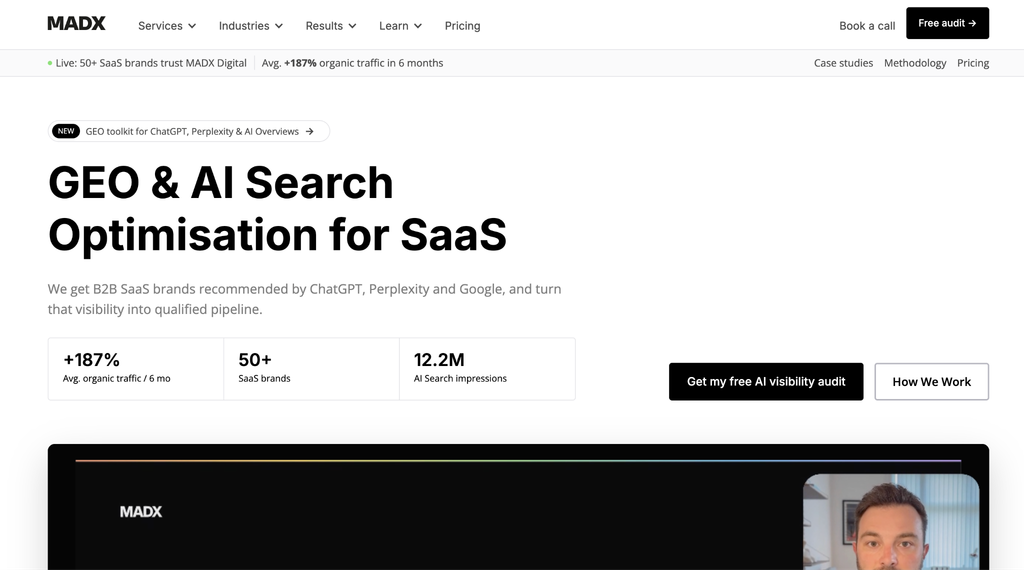
| 1 | MADX Digital | Coordinated strategy and execution | Published tiers; 12-month or 3-month rolling terms |
| 2 | SimpleTiger | Flexible ongoing services | Custom quote |
| 3 | Skale | Specialist SEO support | Scope-dependent quote |
| 4 | Omniscient Digital | Research-led content | Full service from $120,000/year |
| 5 | Directive | Broader B2B coordination | Scope-dependent quote |
1. MADX Digital
Pros
- Competitor-benchmarked technical, on-page and off-site audits
- Keyword and content planning mapped to the buyer journey
- Done-for-you content and website execution from the Growth tier
- Link acquisition through guest posting, digital PR and niche edits
Cons
- The entry Authority tier covers strategy, monitoring and placements, not content or website execution
- The best rate requires a 12-month commitment
Why We Picked It
MADX Digital ranks first for connecting strategy with execution in its published scope. Among the five firms compared here, it is the SaaS SEO consulting firm whose service description most clearly links the initial audit to keyword planning, technical work and authority building, from competitor benchmarking and buyer-journey planning through website improvements and link acquisition.
Its tiers separate advisory work from delivery, giving a lean marketing team a defined way to commission planning first and implementation later. The service description remains vendor-provided evidence. The agency holds 4.9/5 on Clutch from 14 reviews; those reviews are a useful signal, not a forecast of results.
Pricing
Published tiers are Authority, Growth and Scale, with a custom-scoped Enterprise plan above them. Authority centres on strategy, monitoring and placements; Growth adds done-for-you content and website execution; Scale doubles Growth’s output. Plans are billed monthly, with the best rate on a 12-month term or a rolling contract with a three-month minimum.
2. SimpleTiger

Pros
- SEO and GEO, meaning optimisation for visibility in AI-generated answers, from its Startup package upward
- Comparison, use-case and integration content
- Reporting connections to HubSpot, Salesforce, GA4, Google Search Console and Google Ads
- Month-to-month management contracts with 30 days’ notice
Cons
- Main packages require a custom quote after a demo
- The fixed-price GEO Jumpstart is a limited project, not continuing SEO
Why We Picked It
SimpleTiger takes second place for engagement flexibility. It describes month-to-month contracts with 30 days’ notice and no minimum term, and its published services cover research, technical and content optimisation, authority building and conversion recommendations.
Its reporting describes sales opportunities influenced by marketing, revenue connections, acquisition costs and AI-search visibility. We did not test those connections or the dashboard. SimpleTiger holds 4.9/5 on Clutch from 30 reviews.
Pricing
The Startup, Launch, Growth, Control and Enterprise packages are custom-quoted. GEO Jumpstart separately costs $4,000 per month for three months, totalling $12,000, and covers an audit, tracking setup, recommendations and content assets. That figure is not its general SEO retainer.
3. Skale

Pros
- Named strategy, content, technical and off-page specialists
- Technical audits and on-page work alongside conversion improvements
- Keyword and content modelling connected to business outcomes
- GEO audits, rewrites, outreach and prompt testing
Cons
- No fixed retainer was verified on the opened service page
- Complete implementation is an additional-cost option
Why We Picked It
Skale ranks third for in-house teams seeking specialist SEO support. Its named roles clarify responsibility across strategy, content, technical issues and off-page work. We would confirm how those specialists coordinate with your developers and editors.
Its GEO measurement approach covers prompt rankings, mentions, leads, revenue and self-reported discovery information. These measures do not establish that AI visibility caused a sale. Skale holds 4.9/5 on Clutch from 16 reviews.
Pricing
A scope-dependent quote is required. Ask which recommendations your team implements and what complete implementation adds to the fee, especially when internal developers have limited availability.
4. Omniscient Digital

Pros
- Strategy combines search data, buyer research, product positioning and conversion data
- Content informed by brand documents, internal expert interviews and product demos
- Content repurposing included in its process
- Strategy revision built into the engagement
Cons
- Full-service SEO starts at $120,000 per year
- Your experts need time for interviews and product walkthroughs
Why We Picked It
Omniscient Digital ranks fourth for research-led content. Its process connects buyer pain points and product use cases with content planning, using internal expertise to inform production. We see a fit for teams able to contribute product knowledge throughout the engagement, especially where content must match the search intent of buyers comparing tools.
The agency rejects guaranteed or immediate organic-growth expectations. Its review sample is the smallest here, at 4.8/5 on Clutch from 6 reviews, so consider the sample alongside its proposed scope.
Pricing
Full-service SEO starts at $120,000 per year. Ask what production, research and implementation the proposal includes, and what cancellation terms apply.
5. Directive

Pros
- Search strategy mapped to how buyers research and compare vendors
- Content briefs analysing AI Overview sources, formats and opportunities
- Reporting focused on traffic, conversions, sales opportunities and revenue
- Broader services including PR, organic social, influencer marketing and paid social
Cons
- No public retainer was verified on the opened SEO page
- The wider offering may exceed a narrow SEO-only brief
Why We Picked It
Directive ranks fifth for teams coordinating SEO with broader B2B marketing. Its published SEO offering combines technical work, search strategy and commercial opportunity assessment, and its content service describes product-focused pages and AI-visibility tracking.
Its Stratos platform supports strategists by combining customer, marketing, finance and operations information. We treat this as a vendor-described workflow, not independently tested reporting. Directive has the largest review sample here, at 4.8/5 on Clutch from 56 reviews.
Pricing
A scope-dependent proposal is required. Ask whether an SEO-only engagement fits your brief, which implementation tasks it includes, and how other services would be priced.
Conclusion
The first-ranked firm suits coordinated SaaS SEO strategy and execution; for content and website delivery, evaluate its Growth tier or above and confirm responsibilities in writing.
SimpleTiger is the alternative for flexible ongoing terms, while Omniscient Digital fits research-led content briefs. Skale suits teams needing specialist support; Directive fits broader B2B coordination. Request comparable proposals covering deliverables, implementation ownership, reporting definitions and exit terms.
FAQ
Which firm should we shortlist first?
Start with the first-ranked firm for coordinated planning and execution. Add SimpleTiger if flexible commitments are a priority, or Omniscient Digital for a research-led content brief.
How should we compare agency prices?
Compare equivalent scope and commitment periods. Some firms publish tiers with different rates for annual and rolling terms, Omniscient’s starting figure is annual, and SimpleTiger’s $12,000 GEO project is separate from ongoing services. Request scoped quotes from Skale and Directive.
What should we confirm before signing?
Confirm who publishes content, implements technical changes, approves link activity and defines conversions. Ask about working hours, geographic delivery, localisation needs, data access and cancellation terms. A free audit or demo does not constitute free ongoing SEO.
Business
Electric Mountain Bikes Explained: How Motor Assistance, Terrain and Riding Style Shape the Experience


Mountain biking is about more than speed. Trail surfaces, elevation changes, riding technique and the bike itself all influence how a ride feels. Electric mountain bikes add another factor to this mix: motor assistance. By supporting the rider’s pedalling, an electric mountain bike can make climbs more manageable and help riders maintain energy across longer routes.
However, motor assistance does not remove the challenges of off-road cycling. Riders still need to choose suitable lines, manage braking, maintain balance and adapt their effort to changing conditions. Understanding how assistance, terrain and riding style work together can help UK cyclists make better decisions when choosing and riding an electric mountain bike.
For riders researching their options, this guide to electric mountain bikes provides a useful starting point for understanding the factors that influence their performance and suitability. The key is to look beyond the motor and consider how the complete bike fits the terrain you ride and the experience you want.
How Motor Assistance Changes the Riding Experience
An electric mountain bike uses an electric motor to provide additional assistance while the rider pedals. Most systems allow the rider to select different assistance levels, balancing the amount of support against battery consumption and the effort required from the rider.
On a steep climb, a higher assistance setting can make it easier to maintain a steady pedalling rhythm. On flatter sections or gentler trails, a lower setting may provide enough support while conserving battery charge. Riders can adjust assistance according to the terrain, their fitness and the length of the route.
Motor assistance does not replace good technique. Riders still need to maintain traction, select appropriate gears and distribute their weight carefully. Applying too much power on loose gravel, wet roots or muddy ground can cause the rear wheel to lose grip. Smooth, controlled pedalling is often more useful than relying on the highest assistance setting.
Understanding the Different Assistance Levels
Many electric mountain bikes offer several assistance modes. The exact names and behaviour vary by manufacturer, but the general purpose is to let riders adjust the balance between support and energy use.
- Low assistance: Useful on easier terrain, gentle gradients and sections where conserving battery charge is a priority.
- Medium assistance: Can provide a practical balance for rolling trails, moderate climbs and everyday off-road riding.
- High assistance: May help on demanding climbs or when additional support is needed, but can consume battery charge more quickly.
Choosing a mode is a matter of adapting to the trail rather than using maximum assistance throughout the ride. Riders who anticipate changes in gradient and surface can often maintain better control and manage their battery more effectively.
How Terrain Influences Performance
Trail conditions can change the way an electric mountain bike handles and how much assistance the rider needs. A route that feels straightforward on a dry day may become more demanding after rain, while steep climbs can place greater demands on both the rider and the bike.
Steep Climbs
On uphill sections, motor assistance can help riders maintain momentum and reduce the effort required to climb. Choosing a suitable gear and keeping a consistent cadence can make the ascent feel more controlled.
Weight distribution is also important. Keeping the front wheel planted while maintaining enough weight over the rear wheel can help balance steering and traction. If the surface is loose, smooth power delivery can be more effective than sudden increases in pedalling force.
Loose Gravel and Rocky Trails
Gravel, stones and uneven ground require careful steering and controlled braking. Riders should look ahead, choose a suitable line and avoid abrupt changes in direction where possible. Assistance can help maintain forward movement, but it cannot compensate for poor tyre grip or inappropriate speed.
Tyre choice and pressure also affect how the bike responds. The right setup depends on the tyre design, rider weight, terrain and manufacturer recommendations. Riders should avoid making large pressure changes without understanding how those changes affect grip and the risk of damaging a tyre or rim.
Muddy Paths and Wet Roots
Wet conditions can reduce traction and make roots, rocks and painted or wooden surfaces slippery. On these sections, a measured approach is usually best. Lower assistance, gentle pedalling and gradual braking can help riders maintain control.
After a muddy ride, cleaning and drying the bike can help prevent premature wear. Particular attention should be paid to the drivetrain, brakes and other moving components, following the manufacturer’s maintenance instructions.
Flowing Trails and Descents
On flowing trails, riders often benefit more from smooth handling and good line choice than from additional motor power. Look ahead, keep a balanced position and adjust speed before entering corners or technical sections.
Motor assistance generally matters most while pedalling. When descending, braking technique, tyre grip, suspension performance and rider judgement become more important. Riders should select a speed that allows them to respond safely to changes in the trail.
Battery Range: What Riders Should Consider
Battery range is not a fixed distance. It depends on several interacting factors, including battery capacity, assistance level, elevation gain, rider and luggage weight, tyre choice, terrain, temperature and riding technique.
Frequent steep climbs and sustained high assistance can use more energy than a route with gentle gradients and lower assistance. Soft ground and repeated acceleration may also increase energy demand. For this reason, the range quoted by a manufacturer should be treated as an estimate rather than a guarantee for every ride.
Riders can manage battery use by selecting assistance to suit the terrain, maintaining the bike properly and planning a route that matches the available charge. For longer rides, it is sensible to leave a reserve rather than planning to use the battery down to its limit.
Does Cold Weather Affect Battery Performance?
Temperature can influence the performance of lithium-ion batteries. In colder conditions, riders may notice reduced available performance or range compared with milder weather. The actual effect varies according to the battery, its condition and the conditions in which it is used.
Follow the battery manufacturer’s guidance on charging, storage and operating temperatures. Avoid charging a battery outside its permitted temperature range, and inspect it for signs of damage before use. If a battery has been exposed to impact, swelling, unusual heat or other signs of a fault, stop using it and seek advice from the manufacturer or a qualified service provider.
Weight, Suspension and Handling
Electric mountain bikes are often heavier than comparable non-electric mountain bikes because of their motor and battery systems. The additional weight can affect how the bike feels when lifting it, manoeuvring at low speeds or handling tight technical sections.
Suspension design also influences comfort, grip and control. Some bikes are designed primarily for less demanding paths and moderate trails, while others are intended for rougher terrain and more technical riding. The best choice depends on where the bike will be used most often.
When comparing models, consider the complete setup rather than focusing on motor power or battery capacity alone. Frame fit, braking performance, tyre design, suspension, overall weight and service support all contribute to the riding experience.
Adapting Your Riding Style to an E-MTB
Riding an electric mountain bike still requires the fundamentals of off-road cycling. Motor assistance changes how quickly a rider can cover ground or climb a hill, but it does not remove the need for balance, judgement and physical control.
- Look ahead: Scan the trail for obstacles, changes in surface and potential lines before reaching them.
- Pedal smoothly: Gradual power input can help maintain traction, especially on loose or wet ground.
- Brake progressively: Adjust speed before technical sections and avoid sudden braking where grip is limited.
- Choose suitable assistance: Use the level that fits the gradient, surface and remaining battery charge.
- Practise at a manageable pace: Build confidence on familiar, less demanding trails before attempting more technical routes.
New riders should also take time to become familiar with the bike’s additional weight and the way its assistance engages. Practising starts, stops, turns and controlled climbs in a safe area can make the transition to electric mountain biking more comfortable.
UK Trail Access and Responsible Riding
Before setting out, check whether cycling is permitted on the route you intend to use. Access arrangements differ between public rights of way, designated cycle trails, private land and other outdoor areas. A route being accessible to walkers does not automatically mean that cycling is permitted.
In Scotland, the Scottish Outdoor Access Code provides guidance on responsible access and conduct in the outdoors. Elsewhere in the UK, riders should check the relevant local rules, landowner requirements and trail restrictions. Designated trail centres may also publish route grades, closures and guidance for visitors.
Ride at a speed appropriate to visibility, surface conditions and the presence of other trail users. Give walkers and horse riders consideration, slow down when passing and avoid damaging sensitive ground. Responsible riding helps protect access opportunities and keeps shared routes enjoyable for everyone.
UK Electric Bike Rules to Know
In Great Britain, an electrically assisted pedal cycle that qualifies as an EAPC must meet specific requirements. These include a maximum continuous rated motor power of 250 watts and assistance that cuts off when the bicycle reaches 15.5 mph, or when the rider stops pedalling, subject to the rules for permitted systems.
Some approved systems can provide assistance without pedalling up to the permitted speed. However, not every electric bike meets the EAPC requirements. Bikes that fall outside the relevant classification may be treated as motor vehicles and can be subject to different legal requirements.
Before buying or riding, check the specification of the exact model and consult current official UK guidance. Do not assume that every product marketed as an electric mountain bike is automatically legal to use as an ordinary pedal cycle on public roads or cycle routes.
Maintenance and Battery Safety
Regular maintenance helps keep an electric mountain bike working reliably. After riding, check the tyres, brakes, drivetrain and frame for signs of wear or damage. Clean the bike using the methods recommended by the manufacturer, and avoid directing high-pressure water at bearings, electrical connections or other sensitive components.
Battery care deserves particular attention. Use the charger specified or approved by the manufacturer, and do not use a battery that appears damaged or has been modified improperly. Counterfeit or incompatible batteries and chargers can create serious fire risks.
Store and charge the battery according to the manufacturer’s instructions. Keep charging equipment away from escape routes and combustible materials where the guidance advises, and stop charging if you notice unusual heat, swelling, a strange smell or other warning signs. If you suspect a battery fault, discontinue use and contact a qualified service provider.
Choosing an Electric Mountain Bike for Your Needs
The right electric mountain bike depends on your intended use. Riders who mainly explore forest tracks and easier trails may prioritise comfort, straightforward handling and practical battery capacity. Those who regularly ride steep or technical routes may place greater importance on suspension, braking, tyre grip and frame design.
Before choosing a model, consider the following questions:
- What types of trails will you ride most often?
- How steep and long are the climbs on your usual routes?
- What battery capacity and charging arrangements suit your planned journeys?
- Does the bike’s frame size and riding position fit you comfortably?
- Are the brakes, tyres and suspension suitable for your terrain?
- Does the model meet the legal requirements for the way and places you intend to use it?
- Can you access suitable servicing, replacement parts and manufacturer support?
If possible, arrange a test ride before making a decision. A short ride can help you assess the fit, weight, assistance response and handling in a way that specifications alone cannot fully explain.
Final Thoughts
Electric mountain bikes combine the physical and technical aspects of mountain biking with additional pedalling support. Their performance depends on more than motor output: terrain, battery management, tyres, suspension, riding technique and maintenance all influence how the bike feels on the trail.
For UK riders, it is also important to check access rules and make sure the chosen model meets the relevant electric-bike requirements. By choosing a bike that suits your routes, learning how to use assistance smoothly and maintaining the equipment carefully, you can make more informed decisions and enjoy a more controlled off-road riding experience.

Most construction firms have the files. Certificates. Cards. Training logs. Spreadsheets, often lots of them.
That is a compliance record. It is useful. It is also not the same as managing competence.
The gap between the two used to be easy to ignore. It is not any more. That gap is now the core test of competence management in construction.
Two different jobs
Recording compliance tells you who was qualified. It answers questions about the past. Did this person complete the course? Do they hold the right card? When does it expire?
Managing competence tells you who is competent today. It answers questions about the present. Is this person able to do this task, on this project, right now? If not, what is being done about it?
The first is an admin task. The second is a management task. Many organisations treat them as one, and that is where problems start.
What recording looks like
In a firm that records compliance, you will usually see:
- Certificates and cards held in files
- Generic training needs, not role-specific requirements
- Evidence spread across spreadsheets and training systems
- Gaps kept on a separate list
- Records checked when someone remembers to
None of this is wrong. It is just incomplete. It shows that training happened. It does not show that people can apply it.
What managing looks like
In a firm that manages competence, the picture changes:
- Requirements are set by role and activity
- Skills, knowledge, experience and behaviours are evidenced, not just certificates
- Gaps are visible by person, team and project
- Every gap is linked to a development plan
- A change in role, project or scope triggers a fresh look
The difference is not more paperwork. It is a different question. Instead of “do we have the certificate?”, the question becomes “can we show this person is competent for this work?”
Why this matters now
The Building Safety Act changed what is expected. Dutyholders must be able to show competence, not simply state it.
That shift matters most when something goes wrong. After an incident or a concern, the questions are likely to be specific. Who made the decision? What role were they in? Were they competent for it at that moment? Where is the evidence?
A file of certificates is a starting point. It is rarely a full answer to those questions.
Clients and insurers are moving the same way. More of them now ask how competence is managed, not just whether training is in place.
The false sense of security
A training dashboard can look healthy. Nearly everyone is in date. Expiry dates are tracked. Reports are clean.
But that dashboard may say nothing about whether the right people are in the right roles. It may say nothing about how they behave under pressure. It may say nothing about subcontractors on the same site.
That is the risk of recording without managing. Everything looks fine until someone asks a harder question.
Where to start
You do not need to replace everything at once. Start with three honest questions.
1. Can you define competence by role? Not generic training needs. The actual skills, knowledge, experience and behaviours each role requires.
2. Can you see your gaps? By person, by team and by project. And does each gap lead to an action, or just sit on a list?
3. Does change trigger a review? When someone moves projects, when scope shifts, when a new subcontractor arrives. Does anything prompt a fresh check?
If the answer to most of these is “not really”, you are probably recording compliance rather than managing competence. That is common. It is also fixable.
A practical way to think about it
Recording is a snapshot. Managing is a cycle.
A useful model is Plan, Do, Check, Act. Plan what competence each role needs. Do the training, mentoring and supervised practice. Check competence on the job, not just on paper. Act on what you find, and feed the lessons back in.
That cycle is what turns records into assurance.
The bottom line
Records tell you who was qualified. Managing competence tells you who is competent today.
Both matter. But only one will stand up when the work is scrutinised. The firms that close this gap now will not be playing catch-up later.
Answer for how your organisation actually works today, not how the policy says it should. That is where the useful answers are.

Best SEO Consulting Firms for SaaS Companies in 2026

Electric Mountain Bikes Explained: How Motor Assistance, Terrain and Riding Style Shape the Experience

Winter Beard Care: Keeping Your Beard Soft When the Weather Turns

Managing Competence or Recording Compliance? Why the Difference Matters in Construction

Buying Silk for the First Time? What to Check Before You Spend

Who Is Indiana Urban? Inside the Life of Karl Urban’s Son and Rising Actor

Jennifer Seyfried: All About Amanda Seyfried’s Sister, Her Life and Career

Who Is Zachary Hudson? Inside the Private Life of Cindy Williams’ Son

Who Is Stephen G. Walker? All About PinkPantheress’ Father and His Academic Career

Cynthia Womack Biography: The Life, Career, and Legacy of Connie Britton’s Twin Sister
Who Is Indiana Urban? Inside the Life of Karl Urban’s Son and Rising Actor
Jennifer Seyfried: All About Amanda Seyfried’s Sister, Her Life and Career
Who Is Zachary Hudson? Inside the Private Life of Cindy Williams’ Son
Who Is Stephen G. Walker? All About PinkPantheress’ Father and His Academic Career
Cynthia Womack Biography: The Life, Career, and Legacy of Connie Britton’s Twin Sister
-
Biography8 months ago
Who Is Indiana Urban? Inside the Life of Karl Urban’s Son and Rising Actor
-
Biography7 months ago
Jennifer Seyfried: All About Amanda Seyfried’s Sister, Her Life and Career
-
Biography7 months ago
Who Is Zachary Hudson? Inside the Private Life of Cindy Williams’ Son
-
 Biography6 months ago
Who Is Stephen G. Walker? All About PinkPantheress’ Father and His Academic Career
-
Biography8 months ago
Cynthia Womack Biography: The Life, Career, and Legacy of Connie Britton’s Twin Sister
-
 Biography7 months ago
Who is Lynn Levesque? Everything to Know About Triple H’s Sister
-
 Biography7 months ago
Lynn Payne: Inside the Life and Love Story of Randy Savage’s Wife
-
 Biography8 months ago
Who Was Gretchen Knauff? The Private Life of Jennifer Coolidge’s Mother