
Home & Garden
15 Best Flowers for Funerals and Their Meanings


The best flowers for funerals are lilies, roses, carnations, chrysanthemums, orchids, and gladioli because they traditionally express peace, love, remembrance, honor, and strength. The right choice should also reflect the deceased’s personality, the sender’s relationship to the family, and any cultural or religious customs.
Flowers often become part of a larger memorial that may include photographs, personal keepsakes, charitable gifts, and grave markers. While traditional symbolism offers useful guidance, the most meaningful arrangement is one that respectfully represents the person being remembered.
Key Takeaways
- Lilies, roses, carnations, chrysanthemums, orchids, and gladioli are traditional funeral flowers.
- White is the safest color, but brighter flowers may suit a celebration of life.
- Casket sprays are generally chosen by immediate family members.
- Cultural and religious customs should be checked before sending flowers.
- A favorite flower can be more meaningful than one chosen only for symbolism.
What Are the Best Flowers for a Funeral?

Lilies are the most traditional choice for funerals, while roses communicate love and carnations represent remembrance. Chrysanthemums, orchids, gladioli, and hydrangeas are also appropriate, each carrying a distinct message.
No single flower is correct for every service. Formal funerals often feature white or muted arrangements, while celebrations of life may include bright colors, seasonal flowers, or blooms from the deceased’s garden.
1. Lilies: Peace and Purity
Lilies are among the most recognizable funeral flowers. Their calm appearance and traditional association with purity make them suitable for casket sprays, standing displays, wreaths, and vase arrangements.
White lilies represent peace, innocence, and the soul’s return to a peaceful state. Stargazer lilies are commonly associated with sympathy and appreciation. Calla lilies convey elegance, faith, and renewal.
Lilies have a noticeable fragrance, so a less aromatic flower may be preferable when the family has allergies or scent sensitivities.
2. Roses: Love and Respect
Roses communicate personal affection, making them especially appropriate when the sender had a close relationship with the deceased.
Red roses express deep love, courage, and respect. They are often included in tributes for a spouse, partner, parent, or other close relative. White roses represent reverence, purity, and innocence. Pink roses convey grace, gratitude, and appreciation, while yellow roses can honor a loyal friendship.
A single rose placed within a mixed arrangement can also represent an individual bond without dominating the display.
3. Carnations: Remembrance and Devotion
Carnations are widely used in funeral arrangements because they remain fresh for a relatively long time and are available in many colors. Their textured petals work well in wreaths, crosses, hearts, and standing sprays.
White carnations symbolize pure love and innocence. Pink carnations are associated with remembrance and gratitude. Red carnations express admiration and affection.
Their durability makes carnations a practical option for services held over several days or arrangements that will later be moved to a cemetery.
4. Chrysanthemums: Grief and Honor
Chrysanthemums have one of the strongest cultural connections to mourning. In several European and East Asian traditions, white chrysanthemums are closely associated with funerals, grief, loyalty, and remembrance.
Their meaning is less fixed in the United States, where chrysanthemums may also represent friendship, optimism, or longevity. Cultural background therefore matters when choosing them.
White chrysanthemums are generally the safest choice for a traditional tribute. A florist familiar with the family’s culture can help determine whether other colors are appropriate.
5. Orchids: Enduring Love
Orchids represent lasting affection, beauty, and enduring love. White and pale pink orchids are the most common choices for sympathy arrangements because their understated colors feel graceful without appearing impersonal.
Cut orchids can be added to a premium floral display, while a potted orchid may be sent to the family’s home. A living plant lasts beyond the service and can become a quiet reminder of continuing support.
6. Gladioli: Strength of Character
Gladioli symbolize integrity, sincerity, and moral strength. Their tall stems create height and structure, making them particularly effective in standing sprays and large formal arrangements.
These flowers are appropriate when honoring someone admired for leadership, courage, service, or strong principles. They are frequently combined with roses, lilies, or carnations to balance their vertical form.
7. Hydrangeas: Heartfelt Emotion
Hydrangeas represent sincere emotion, understanding, and gratitude. Their large flower heads create a full, generous-looking arrangement without requiring numerous individual stems.
White hydrangeas suit traditional funerals, while blue and purple varieties introduce calm, reflective color. A potted hydrangea can also be given to the family as a living tribute, although its long-term care depends on the local climate and growing conditions.
8. Forget-Me-Nots: Lasting Memory
Forget-me-nots directly communicate remembrance and an enduring emotional connection. Their small blue flowers work best as accents in garden-style arrangements rather than as the main bloom.
They can be especially meaningful for an intimate memorial, anniversary tribute, or graveside arrangement focused on memory and continued love.
9. Irises: Faith and Hope
Irises traditionally represent faith, wisdom, courage, and hope. Blue and purple irises add dignified color to an arrangement while maintaining a peaceful tone.
They are well suited to spiritual services or tributes honoring someone known for wisdom, guidance, or resilience. Irises also pair naturally with white lilies, roses, and hydrangeas.
10. Tulips and Daffodils: Renewal
Tulips and daffodils symbolize renewal, hope, and the return of spring. They are particularly appropriate for celebrations of life that emphasize gratitude, optimism, and cherished memories.
White tulips feel serene and formal. Pink tulips express care, while yellow tulips and daffodils create a warmer, more uplifting effect. Because these flowers are seasonal, availability may vary.
11. Sunflowers: Loyalty and Warmth
Sunflowers represent loyalty, admiration, and warmth. Although they are less traditional than lilies or roses, they can be deeply appropriate for someone remembered for an energetic, generous, or cheerful personality.
They work best in celebrations of life, rustic memorials, and personalized services. Pairing sunflowers with white flowers or greenery can soften their brightness while preserving their positive character.
12. Peace Lilies: Comfort and Continuing Support
A peace lily is a living plant rather than a cut flower. It symbolizes peace, healing, and renewal and is generally delivered to the family’s home instead of displayed as a formal funeral piece.
The plant may continue growing for years, giving the recipient a lasting reminder of sympathy. Care requirements should be considered, particularly if the household has pets, since peace lilies can be harmful if chewed or swallowed.
13. Daisies: Innocence and Simplicity
Daisies symbolize innocence, purity, and loyal love. White daisies can create a gentle, natural tribute for someone remembered for kindness, humility, or a love of the outdoors.
They may also appear in memorials for children, although the family’s preferences should always guide the arrangement. Mixed garden flowers can feel more personal than a highly formal display.
14. Baby’s Breath: Everlasting Love
Baby’s breath represents purity, innocence, and everlasting love. It is usually used as a supporting flower, adding softness and space around roses, carnations, or lilies.
Although often treated as filler, baby’s breath can carry meaningful symbolism. A cloud-like arrangement made primarily from these small white flowers creates a restrained and peaceful tribute.
15. A Favorite Flower: Personal Remembrance
The deceased’s favorite flower is often the most meaningful choice, even when it has no traditional connection to funerals. Peonies, wildflowers, lavender, dahlias, garden roses, or native plants can evoke specific memories and make the service feel personal.
Flowers may also reflect a favorite season, hometown, hobby, school color, military service, or beloved garden. Personal relevance should take priority over rigid rules of floral symbolism.
What Do Funeral Flower Colors Mean?
Flower color can communicate as much as the variety itself.
White represents peace, purity, reverence, and innocence. It is the most universally accepted funeral color. Red communicates deep love, courage, and respect. Pink conveys tenderness, grace, and gratitude.
Blue suggests peace, serenity, and thoughtful remembrance, while purple is associated with dignity and admiration. Yellow often represents friendship, warmth, and a life remembered with affection.
Bright, multicolored arrangements are appropriate when the family requests a celebration of life or when vivid colors reflect the deceased’s personality. A funeral tribute does not always need to look somber.
Choosing the Right Type of Arrangement
Casket sprays are placed directly on the casket and are normally selected by the immediate family. Standing sprays and wreaths are displayed on easels and may be sent by relatives, friends, employers, or organizations.
Floral hearts and crosses often communicate close affection or religious faith. Vase arrangements, baskets, and potted plants are suitable for delivery to the family’s home and are commonly described as sympathy flowers.
Before ordering, check the obituary or funeral announcement. It may provide delivery instructions, name a preferred florist, request charitable donations, or state that flowers should not be sent.
Funeral Flower Etiquette
Funeral customs differ among families, religions, and cultures. Flowers are common at many Christian services, but they may not be customary at Jewish funerals. Practices within Muslim, Hindu, Buddhist, and East Asian communities also vary.
Never assume that one tradition applies to every family. Follow the obituary, contact the funeral home, or ask a close relative when expectations are unclear.
Flowers should arrive before the visitation or service when they are intended for display. Sympathy arrangements sent to the home may arrive before or after the funeral. A short card should identify the sender and offer a sincere message such as, “With deepest sympathy,” or “Remembering a life that meant so much to so many.”
A Meaningful Choice Matters Most
The best funeral flowers communicate respect while reflecting the life and relationships being honored. Lilies offer peace, roses express love, carnations preserve remembrance, and gladioli recognize strength. Personal flowers add another layer of meaning that traditional symbolism cannot always provide.
The goal is not to choose a perfect bloom. It is to offer comfort, acknowledge loss, and create a thoughtful tribute to a life that deserves to be remembered.

Walking through a garden center can feel overwhelming. With endless rows of shrubs, flowers, and trees, how do you decide what belongs in your yard? Picking the wrong plants often leads to wasted money and dead foliage. However, with a solid plan, you can create a thriving landscape that boosts curb appeal and provides enjoyment for years.
This guide breaks down the essential steps to selecting greenery that fits your environment, style, and maintenance ability. By understanding your space and what plants need to survive, you can build a garden that flourishes.
Assess Your Site Conditions
Before buying a single seed or sapling, you must understand the environment where they will live. Plants have specific needs, and ignoring them usually leads to failure.
Sunlight Availability
Observe how the sun moves across your property. Areas that receive six or more hours of direct sun are considered “full sun.” Locations with three to six hours have “partial shade,” while spots with less than three hours of direct light are “full shade.” Buying a shade-loving hosta for a sun-drenched corner will scorch its leaves, while putting a rose bush in deep shade will result in poor blooms and disease.
Soil Quality
Your soil type dictates how water drains and what nutrients are available. Clay soil holds water but can suffocate roots if it gets too compacted. Sandy soil drains quickly but might not retain enough moisture or food for hungry plants. You can improve most soil with compost, but choosing species adapted to your native ground is always easier.
Hardiness Zones
The USDA Plant Hardiness Zone Map is a critical tool. It divides regions by their average minimum winter temperature. Ensure any perennial, shrub, or tree you select is rated for your specific zone. If you choose a tropical plant for a northern climate, it will not survive the winter outdoors without significant protection.
Define the Purpose of Your Plants
Every plant in your landscape should have a job. Knowing what you want to achieve helps narrow down the massive selection available.
Creating Privacy and Screening
If your goal is to block a view of the neighbor’s garage or reduce street noise, look for dense, fast-growing evergreens. Arborvitae or holly bushes can form living walls that provide year-round coverage.
Adding Color and Interest
Deciduous shrubs and flowering perennials bring seasonal excitement. Plan for a succession of blooms so something is always colorful from spring through fall. Bulbs like tulips work for early spring, while daylilies shine in summer, and mums offer autumn vibrancy.
providing Shade and Structure
Trees are the anchors of a landscape. A large oak or maple provides cooling shade that can lower energy bills. Smaller ornamental trees, like dogwoods or Japanese maples, add structural beauty and focal points near patios or entryways.
Consider Maintenance Levels
Be honest about how much time you want to spend working in the yard. Some landscapes require weekly attention, while others thrive on neglect.
High-Maintenance Options
Roses, fruit trees, and formal hedges often need regular pruning, fertilizing, and pest control. If you love gardening as a hobby, these are rewarding choices. If you prefer to relax on weekends, they might become a burden.
Low-Maintenance Alternatives
Native plants are generally the best choice for easy care. Because they evolved in your region, they are adapted to local rainfall and pests. Ornamental grasses and sedums are other excellent low-maintenance picks that look great with minimal effort. When visiting a Salt Lake City plant nursery or a local garden center in your specific region, ask the staff to point out species that are drought-tolerant and disease-resistant.
Spatial Planning and Growth Habits
One of the most common mistakes is planting for the current size of the pot, not the mature size of the plant.
Give Plants Room to Breathe
That small juniper might look cute now, but if the tag says it grows eight feet wide, believe it. Planting too close to your house or walkways leads to constant pruning battles later. Proper spacing ensures good air circulation, which reduces fungal diseases.
Layering for Depth
Think vertically when arranging your beds. Place tall plants in the back, medium-sized ones in the middle, and low-growing ground covers in the front. This layering technique creates visual depth and ensures every plant gets seen.
Water Requirements
Group plants with similar water needs together. This practice, known as hydro-zoning, saves water and keeps plants healthy. You should not put a thirsty willow tree next to a drought-loving lavender bush because you will either drown one or dehydrate the other.
Choosing the right plants involves research and patience. By analyzing your sunlight, soil, and lifestyle, you can select varieties that will thrive in your specific landscape. The result will be a beautiful, sustainable outdoor space that adds value to your home.

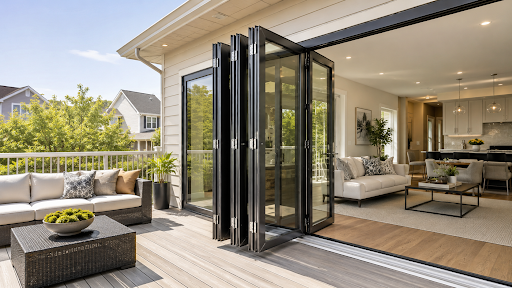
What are folding patio doors?
Folding patio doors are glazed door systems whose panels hinge to each other and stack to one or both sides of an opening. Each panel rides a track, the leaves fold in pairs, and a 16-foot opening can clear almost completely. Residential systems carry 2 to 10 panels, and the panel count drives both the hardware schedule and the price. New Jersey plan sets file the category under three names: folding patio door, bi-fold door, and accordion door.
Folding patio doors differ from sliding doors in one structural respect: the panels leave the plane of the wall. A folding system stacks its leaves perpendicular to the wall, so the layout needs clear stack space beside the opening. The International Residential Code (IRC), adopted in New Jersey through the Uniform Construction Code, treats the assembly as an exterior door. Landing and threshold rules follow from that classification.
How do folding patio door configurations work?
Folding patio door configurations are written as a panel count plus a stacking direction. A four-panel set that folds entirely to the left reads as 4L, and the same four panels splitting evenly read as 2L2R. Manufacturers count panels from the exterior, so a drawing note matches the site only when the viewing side is stated.
Traffic panel choice separates daily use from seasonal use. A traffic panel, also called an access door, is a single leaf hinged at the jamb that swings without moving the rest of the stack. Systems without one need the full set to fold before anyone steps outside, which suits a screened porch more than a kitchen exit.
Panel width and weight cap the practical count. Residential aluminum systems commonly hold a single leaf near 42 inches wide, and leaf weights reach 250 pounds at full height. Hardware schedules list a maximum leaf weight, and that figure, not the opening width, sets the final panel count.
Which threshold types are used at the sill?
Threshold type governs water management, flooring transitions, and accessibility at every folding door. Three sill families cover almost all New Jersey installations, and each one trades weather resistance against a flat walking surface. The sill decision belongs on the drawing before the slab pour, because sill height sets the subfloor detail.
Weathered sill
Weathered sills raise a rebated upstand of 2 inches or more between the interior floor and the track. The upstand holds wind-driven rain outside and feeds weep channels, the small drainage openings that carry water away. Water penetration ratings run highest in this family, which is why exposed elevations and shore-facing walls use it.
Low-profile sill
Low-profile sills stand near 1 inch above the finished interior floor and keep a shallow drainage channel inside the track. The reduced upstand still sheds water on protected elevations, such as a wall under a deep roof overhang. Tested water ratings sit below the weathered version, and the product data sheet records the tested pressure.
Flush sill
Flush sills, also called zero thresholds, finish level with the interior floor and drain through a trench grate outside. Americans with Disabilities Act (ADA) Standards for Accessible Design limit a threshold at a doorway to 0.5 inch, with a bevel required above 0.25 inch. Flush details need a recessed structural pocket, a linear drain, and positive slope away from the opening.
How do New Jersey codes shape the opening?
New Jersey regulates door openings through the Uniform Construction Code, which adopts the IRC and the International Energy Conservation Code (IECC) as subcodes. The IRC limits the drop from the top of the threshold to the exterior landing at a required egress door to 1.5 inches. Deck and patio elevations therefore get set against the sill height rather than the reverse.
Energy limits follow climate zone. Most New Jersey counties sit in IECC climate zone 4A, and the northwestern highlands fall into zone 5A. The prescriptive fenestrationU-factor, the measure of heat loss through a whole window or door assembly, is 0.32 in zone 4 and 0.30 in zone 5. The frame reaches those numbers with a thermal break, an insulating polyamide strip between the interior and exterior aluminum.
Wind pressure governs hardware and glass on exposed sites. Coastal New Jersey counties carry higher design wind pressures than inland ones, and the required design pressure rating appears on the manufacturer’s certification label. The North American Fenestration Standard, published as AAMA/WDMA/CSA 101/I.S.2/A440, reports air, water, and structural results on one certification line.
What does the structural opening require?
Structural openings for folding doors carry a deflection limit tighter than a standard wall opening. Specifications for a glazed folding system commonly set header deflection at L/600, meaning the beam moves no more than its span divided by 600. A 16-foot header at that limit moves less than one third of an inch. Deflection past the limit binds the panels and drags the track.
Top-hung and bottom-rolling systems load the building differently. A top-hung system suspends every panel from the header track, so the beam above carries the full glass weight. Renovation projects in older New Jersey housing stock often use bottom-rolling hardware, since upgrading an existing header means opening the wall above.
Installation tolerance stays narrow across the whole assembly. ASTM E2112, the standard practice for installing exterior windows and doors, calls for a sill pan with end dams and a back dam under the unit. Out-of-level sills show up immediately in a folding door, because the panels hang in series and a small twist multiplies across the stack.
A specification sequence that prevents rework runs in four steps:
- Record the rough opening, the stack side, and the traffic panel location.
- Fix the sill type against the exterior finish elevation and the drainage path.
- Size the header for the deflection limit and the hardware weight.
- Match the glass to the climate zone U-factor and the site design pressure.
Configuration and threshold reference table
Configuration and threshold pairings follow the exposure and the daily use of each opening. The table sets out common residential combinations in New Jersey.
| Configuration | Typical opening width | Sill that fits | Construction note |
| 2L or 2R | 6 to 8 feet | Weathered or low-profile | Standard header, stack depth under 4 feet |
| 3L or 3R | 9 to 12 feet | Low-profile under cover | Traffic panel keeps daily access simple |
| 2L2R | 12 to 16 feet | Weathered on exposed walls | Both jambs need stack space |
| 3L3R | 18 to 24 feet | Flush with a trench drain | Engineered header, structural review |
What drives the cost and lead time?
Cost on a folding patio door builds from four separate line items rather than one price per foot. Panel count sets the hardware and the labor hours, and sill type sets the drainage and flooring work. The glass package sets the U-factor and the acoustic result, while frame material moves the base price. Quotes returned for folding patio doors nj vary widely because those items get priced separately.
Structural work sits outside most door quotes. Header replacement, a new footing under a stack point, and a trench drain at a flush sill are construction costs. A folding patio doors nj quote that leaves out the sill type and the drainage detail leaves the flooring interface undefined.
Regional supply chains shape lead time more than list prices do. European profile suppliers such as Reynaers, Schüco, and Rehau stand behind many aluminum folding systems sold in New Jersey. Buyers searching for folding patio doors nj reach fabricators who run design, permit drawings, manufacturing, and installation as one chain. Vision Art Aluminium works that way from a Montclair showroom covering New Jersey and New York.
Common mistakes in folding door drawings
Drawing errors on folding door openings repeat in a small set of patterns, and each one surfaces after the frame reaches the site.
- Stack space left off the plan, which parks the folded panels in front of a window.
- Sill type unspecified, so the flooring contractor sets the finished height before the door detail exists.
- Exterior landing poured level with a flush sill, with no trench drain and no slope away from the wall.
- Traffic panel swing drawn from the interior while the manufacturer counts from the exterior.
Which configuration fits which New Jersey opening?
Opening width and exposure decide the configuration faster than style preference does. Openings up to 12 feet work with two or three panels and a low-profile sill on a covered elevation. Openings past 16 feet move to a split stack, an engineered header, and a weathered sill on any exposed wall. Flush thresholds suit projects that can build a trench drain into the slab. Traffic panel placement, stack side, and sill height stay fixed after fabrication.
Product specifications, code editions, and prices change over time. Verify the current New Jersey subcode edition and the local design pressure requirement with the municipal construction office. Confirm the manufacturer’s tested ratings on the product data sheet before ordering.
Frequently Asked Questions
What is a folding patio door?
A folding patio door is a glazed door system whose panels hinge together and stack to one or both sides of an opening. Residential systems run from two to ten panels. The design clears most of the opening, while a sliding door keeps one panel across the width.
Which threshold type handles New Jersey weather?
Threshold performance rises with the height of the upstand. A weathered sill of 2 inches or more resists wind-driven rain on exposed elevations and shore-facing walls. A low-profile sill near 1 inch suits walls under a deep overhang. A flush sill needs a trench drain and positive slope to match either one.
How much stack space does a folding patio door need?
Stack space equals the panel width plus a small allowance for each folded leaf and its hardware. A four-panel system with 42-inch leaves stacking one way projects about 4 feet from the jamb. That depth lands inside the room on an inward stack and on the terrace outside.
Do folding patio doors need a permit in New Jersey?
New Jersey’s Uniform Construction Code requires a construction permit whenever a project creates or enlarges a structural opening. Cutting a wall for a folding door falls under that rule, and a sealed structural detail normally accompanies the application. Municipal construction offices confirm whether a same-size replacement counts as ordinary maintenance.
How does a folding patio door differ from a sliding door?
A folding patio door stacks its panels perpendicular to the wall and clears nearly the entire opening. A sliding door parks panels behind one another and keeps at least one panel across the width. Folding systems carry more hardware, more weather seals, and a heavier header load.
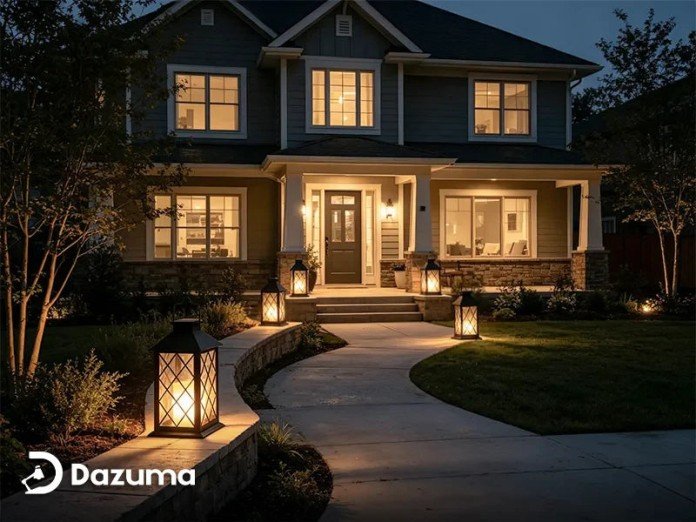
The exterior of a home should remain practical and welcoming after daylight fades. Without suitable lighting, steps become difficult to see, entrances feel less inviting, and architectural features disappear into the darkness. A few carefully selected wall lights can improve visibility while giving the building a more polished appearance.
Outdoor wall lighting is available in many forms, including traditional lanterns, compact downlights, modern up-and-down fixtures, linear sconces, motion-activated lights, and solar-powered designs. Choosing between them involves more than finding a fixture that looks attractive. Homeowners should also consider its purpose, position, brightness, weather resistance, scale, and relationship with the architecture.
Begin with the Purpose of Each Light
Before comparing finishes and shapes, decide what each fixture needs to accomplish. A light beside the front door may need to illuminate locks, house numbers, parcels, and visitors’ faces. A fixture near a side passage should make obstacles easier to see, while patio lighting may focus more on comfort and atmosphere.
Walk around the property after dark and identify areas where visibility is poor. Pay attention to steps, gates, doorways, garage entrances, narrow paths, and changes in ground level. These practical locations should usually be addressed before purely decorative areas.
Next, note the architectural features that deserve attention. Textured brick, natural stone, timber cladding, columns, and carefully designed entrances can all benefit from controlled illumination. When one fixture can support both visibility and architectural emphasis, the lighting plan becomes simpler and more effective.
Match the Fixture Style to the Architecture
A wall light should feel connected to the building rather than attached as an afterthought. Traditional lanterns suit cottages, period properties, and homes with classic doors or decorative masonry. Simple rectangular fixtures complement contemporary exteriors, while industrial-style lights can work well with brick, metal, and converted spaces.
Dazuma’s collection of Outdoor Wall Lighting shows how varied the category has become, with lantern-inspired fixtures, minimalist LED forms, linear sconces, solar options, and up-and-down designs. This variety makes it possible to choose a light that supports the character of the property instead of competing with it.
The fixture does not have to match every exterior detail exactly. Repeating one element—such as a black finish, warm metal tone, rectangular shape, or type of glass—is often enough to create a consistent visual relationship.
Choose the Correct Size
Scale is one of the most common sources of disappointment. A small wall light may look insignificant beside a wide entrance or large garage door. An oversized fixture can overwhelm a narrow doorway and shine into nearby windows.
Consider the dimensions of the wall, door, and surrounding architectural features. A fixture beside a single entrance door should normally remain clearly smaller than the door itself, while a large double entrance may support more substantial lights. Where two matching fixtures are installed on either side of a doorway, each can be slightly smaller because the pair creates a stronger combined presence.
Check the fixture’s projection from the wall as well as its height and width. A deep lantern may interfere with a narrow passage, door swing, downpipe, or garden gate even when its front-facing dimensions appear suitable.
Position Lights at a Comfortable Height
Outdoor wall lights should illuminate useful areas without shining directly into people’s eyes. Fixtures installed beside an entrance are commonly positioned around eye level or slightly above it, but the ideal height depends on the fixture’s proportions, beam direction, door design, and ceiling height.
Ask another person to hold a cardboard template against the wall before drilling. View it from the pavement, driveway, and doorway to judge whether the size and position feel balanced. This simple test can reveal problems that are difficult to recognise from measurements alone.
For up-and-down lights, make sure there is enough clear wall above and below the fixture for the beams to develop. Rooflines, signs, plants, window frames, and other obstructions can interrupt the intended effect.
Control Light Direction and Glare
Brighter lighting is not always better. A powerful unshielded light can make it harder to see by creating glare and deep shadows. The goal is to place light where it is needed while keeping the source as comfortable as possible.
Downward-facing fixtures work well above steps, pathways, and doors because they direct illumination towards the ground. Up-and-down lights produce decorative beams on the wall and can emphasise vertical architecture. Lanterns with diffused or frosted glass provide a softer general glow, while clear glass reveals the bulb and creates a more traditional appearance.
Check the beam from inside the house as well. A badly positioned fixture may shine through bedroom or living-room windows. Adjusting the height, selecting a lower lumen output, or choosing a more controlled beam can prevent unwanted indoor glare.
Select an Appropriate Colour Temperature
Colour temperature describes whether white light appears warm, neutral, or cool. Warm white light generally complements brick, timber, stone, and traditional architecture. It creates a relaxed atmosphere around front entrances, terraces, and garden seating areas.
Neutral white can provide clearer visibility around garages, side passages, and modern façades. Very cool light may appear harsh in residential settings, especially when neighbouring fixtures use a warmer tone.
Consistency matters. Wall lights visible together should usually have the same or closely related colour temperatures. A warm lantern beside a cold blue-white garage light can make the exterior appear disconnected, even when the fixtures are attractive individually.
Look Beyond Wattage When Comparing Brightness
Modern LED fixtures use much less energy than older bulbs, so wattage is no longer the clearest measure of brightness. Compare lumen output instead. A front entrance may need enough illumination for identification and access, while a patio may benefit from gentler light that does not dominate the evening atmosphere.
Also consider how the shade and beam angle affect the perceived brightness. An enclosed diffuser spreads light differently from a narrow directional fixture. Dark wall materials absorb more illumination, while pale surfaces reflect it and can make the same fixture appear brighter.
Dimming can provide useful flexibility in entertaining areas, but the fixture, driver, bulbs, and control must be compatible. Check the product specifications before selecting a dimmer.
Confirm the Weather Rating
Indoor wall lights should never be assumed suitable for exterior use. Outdoor fixtures must tolerate rain, condensation, dust, temperature changes, and prolonged exposure to sunlight. Check the manufacturer’s location or ingress-protection rating and make sure it is appropriate for the intended position.
A light under a deep covered porch experiences different conditions from one mounted on an exposed coastal wall. Properties near the sea also require materials and finishes capable of resisting salt-related corrosion. Powder-coated aluminium, stainless steel, brass, and properly sealed glass are common exterior options, but their suitability depends on construction quality and maintenance.
When researching different materials and styles, broader ranges from Dazuma Lighting can help homeowners compare exterior fixtures alongside other lighting categories and plan a more coordinated scheme.
Consider Motion Sensors and Timers
A motion sensor can be helpful beside a side gate, garage, bin-storage area, or less frequently used entrance. It provides light when someone approaches without leaving the fixture operating throughout the night. However, poor sensor placement may allow passing traffic, pets, or moving plants to trigger it repeatedly.
Choose a model with adjustable detection range, sensitivity, and operating time where possible. Aim the sensor towards the area people actually use rather than towards the street or a neighbouring property.
Photocells and timers offer another approach. A photocell turns the light on when natural light levels fall, while a timer can switch it off later in the evening. Combining automatic control with efficient LEDs can reduce unnecessary energy use.
Plan a Consistent Exterior Scheme
A home may need several types of outdoor light, but they should still feel related. Entrance lanterns, patio sconces, garage lights, and landscape fixtures do not have to come from one collection. They can be coordinated through finish, shape, glass style, colour temperature, or beam character.
Avoid allowing every fixture to compete for attention. Choose one important area—usually the main entrance—as the visual focus. Supporting lights can then use simpler forms or lower brightness levels. This hierarchy gives the exterior depth without making it appear overdesigned.
View the complete plan from the street before purchasing. Consider which lights will be visible together and how they relate to windows, doors, rooflines, and landscaping.
Install Outdoor Fixtures Safely
Exterior electrical work must be protected from moisture and completed with suitable weatherproof components. The mounting surface should be stable, and cable entries must be sealed according to the fixture manufacturer’s instructions. Avoid trapping water behind the fitting or blocking drainage features designed into the product.
If new wiring, circuit alterations, or unfamiliar electrical connections are required, use a qualified electrician. Professional installation is especially important where the wall is exposed to heavy rain, where the existing wiring is old, or where several fixtures and controls are being added at once.
Keep the Lights Performing Well
Outdoor fixtures require occasional maintenance. Clean glass and diffusers so dirt does not reduce light output. Remove cobwebs, check mounting screws, trim plants that block the beam, and inspect the finish for early signs of corrosion.
After storms or freezing weather, confirm that fittings remain secure and that water has not entered the enclosure. Replace damaged seals and failed bulbs with components that match the original specifications.
A Small Change with a Noticeable Effect
Outdoor wall lighting can improve the appearance, safety, and everyday usability of a home without requiring a major renovation. The best results come from understanding the purpose of each fixture, choosing a suitable scale and beam direction, controlling glare, and using materials designed for the installation environment.
With careful placement and a consistent lighting style, entrances become more welcoming, pathways feel easier to navigate, and architectural details remain visible after sunset. The exterior gains character while continuing to serve the practical needs of the people who use it.

Securing Industry 4.0: Mitigating Electrical Transients in Smart Manufacturing

Where to Spot Bears in Alaska: A First-Timer’s Wildlife Guide

Why Smart Factories Need Stable Production Conditions

Small Space, Big Profits: Smart Seating Layouts for Tiny Dining Rooms

8 Workforce Challenges Facing Modern Construction

Who Is Indiana Urban? Inside the Life of Karl Urban’s Son and Rising Actor

Jennifer Seyfried: All About Amanda Seyfried’s Sister, Her Life and Career

Who Is Zachary Hudson? Inside the Private Life of Cindy Williams’ Son

Who Is Stephen G. Walker? All About PinkPantheress’ Father and His Academic Career

Cynthia Womack Biography: The Life, Career, and Legacy of Connie Britton’s Twin Sister
Who Is Indiana Urban? Inside the Life of Karl Urban’s Son and Rising Actor
Jennifer Seyfried: All About Amanda Seyfried’s Sister, Her Life and Career
Who Is Zachary Hudson? Inside the Private Life of Cindy Williams’ Son
Who Is Stephen G. Walker? All About PinkPantheress’ Father and His Academic Career
Cynthia Womack Biography: The Life, Career, and Legacy of Connie Britton’s Twin Sister
-
Biography7 months ago
Who Is Indiana Urban? Inside the Life of Karl Urban’s Son and Rising Actor
-
Biography7 months ago
Jennifer Seyfried: All About Amanda Seyfried’s Sister, Her Life and Career
-
Biography7 months ago
Who Is Zachary Hudson? Inside the Private Life of Cindy Williams’ Son
-
 Biography5 months ago
Who Is Stephen G. Walker? All About PinkPantheress’ Father and His Academic Career
-
Biography7 months ago
Cynthia Womack Biography: The Life, Career, and Legacy of Connie Britton’s Twin Sister
-
 Biography6 months ago
Who is Lynn Levesque? Everything to Know About Triple H’s Sister
-
 Biography7 months ago
Who Was Gretchen Knauff? The Private Life of Jennifer Coolidge’s Mother
-
 Biography6 months ago
Lynn Payne: Inside the Life and Love Story of Randy Savage’s Wife