
Business
The Ultimate Master Guide to Choosing the Right Collapsible Rigid Boxes

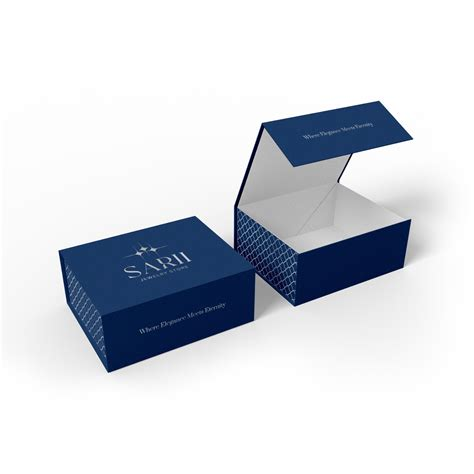
Many of us do not know but the packaging choice that we make sends out a signal to our customers which they receive even before opening the box. The weight, rigidity and the way the lid of our boxes opens register instantly in the minds of our customers. This happens often before they even read the label. This phenomenon may be termed as a part of why collapsible rigid boxes have become more than a niche across almost all of the businesses related to luxury and fashion.
These boxes come with all the perks of standard rigid boxes but with the added benefit of being foldable, which is highly beneficial for storage and shipping. If you are also inspired by their abundant benefits, this breakdown will give you an insight on what you should look for before placing your order. .
Understanding the Fold-Flat Advantage
Rigid boxes are termed rigid for a reason. They are stiff and unbendable, whether full or empty. You simply cannot ship them in a minimal way.
A collapsible rigid box, on the other hand, strategically gets around this with scored panels and reinforced folding points. This means that they are flat for transport and storage and yet firm and stable once they are assembled. Brands benefit from their structural presence and customers associate them with premium packaging, all this without absorbing the freight and warehouse costs.
The Main Structural Formats
The build of collapsible rigid boxes is not similar at all. So before committing to a supplier you need to know the common formats that you can benefit from.
- Corner lock designs – This structure is most common. It has scored corners that fold inwards with a basic base that clicks into a fixed position.
- Magnetic flap boxes – They can fold into an absolutely flat position and click back using an internal magnetic strip that is hidden inside their walls.
- Hinged book-style boxes – Just as their name suggests, they resemble the opening style of a book. They are suitable for gift sets and for products that need to be displayed in layers.
- Slide out drawer boxes.– These boxes have an inner tray that is nested neatly inside a rigid outer sleeve. They give a slower, more relaxed and deliberate reveal.
- Two-piece lid and base boxes – As the name says, they come in two pieces. They have a simpler collapsible structure that can fold flat. It is one of the most cost-efficient foldable options.
Choosing the right box style depends on the needs of your product and also the style choices of your target customers.
Print Finishes That Actually Move the Needle
Structure forms the foundation but printing is actually what makes your packaging box a hit in the market. We can say the structure can get your products to your customers in the best possible shape. But the way they are printed is what will make your customers stop and look at them. With printable collapsible boxes you get
- Clean and detailed artwork with the help of digital and offset printing.
- Foil stamping in various hues for logos and code areas.
- Embossing and debossing that adds detail to the box finish.
- Practical and aesthetic finishes like spot UV that highlight over a matte background.
- Smudge-free and soft-touch laminate that completely changes how the box feels in hand.
The finishes of luxury collapsible packaging specifically gravitate brands that aim for a higher price point for their products.
Questions to Ask Before You Order
No matter if you’re trying to get collapsible rigid boxes wholesale or a smaller custom batch of them, you still need to follow a specific checklist to get the right product that you actually need.
- Ask your supplier if they would be able to send you a physical sample before you agree to the complete order.
- Find out about the minimum order quantity and also verify all your suppliers’ pricing sheets if you increase order volume.
- See if the supplier provides you with accurate die line templates.
- Check reviews and research online whether the supplier is reliable enough to meet your deadline.
- See if they’re able to match your product’s actual load by adjusting the board rate and GSM.
You may almost always get better prices per unit with higher order volumes. And you can often predict your demand so plan further ahead instead of placing small more frequent orders.
Picking the Right Fit for Your Product
The choice of best rigid packaging for your use entirely depends on what you are going to put inside of it.
- If you have heavier or fragile items, you will need a corner-lock structure that has a reinforced base.
- If you have multi-item sets and gift bundles, they perform a lot better in book-style or drawer formats that actually build a revealing moment.
- For lightweight items and accessories, a two-piece design often does very well and also keeps the cost per unit down. The best part is it also does not look cheap.
Choosing the ideal collapsible rigid box structure is more of a branding decision than a packaging one. This type of packaging combines the benefits of conventional rigid boxes with the convenience of not having to deal with the storage and transportation issues that have rendered many rigid packaging options unviable in the first place.

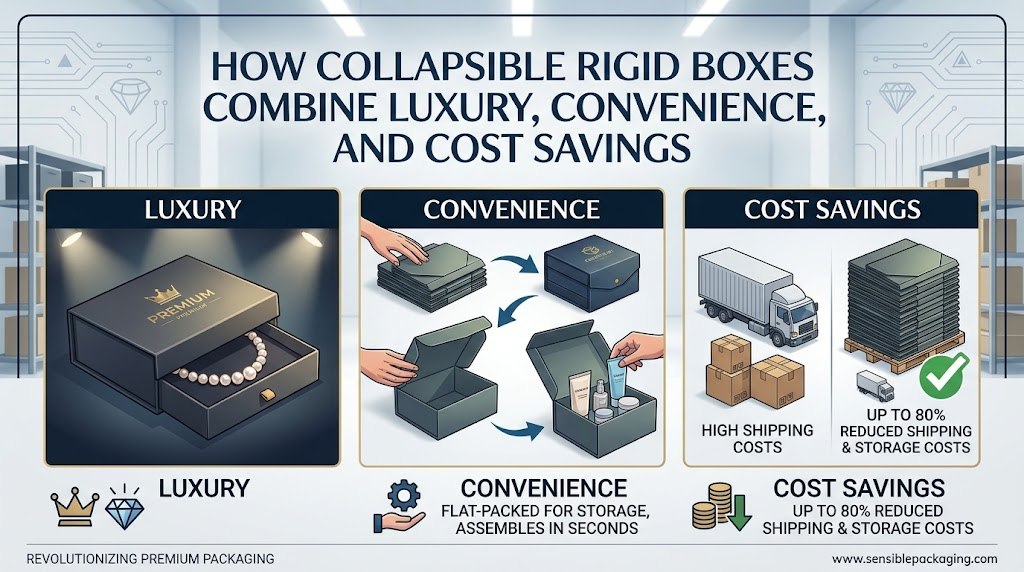
Now a brand often has to choose between a fancy presentation or a convenient packaging. It may also have to choose between inexpensive wrapping and something that is easy to ship. Luxury and cost-effective options rarely go together. The former usually takes up more space, but most of the latter is easy to transport and not very presentable.. Collapsible rigid boxes are one of the rare exceptions where all three actually meet in the same product.
This is not a marketing exaggeration. The engineering behind these boxes genuinely solves three separate problems at once. Once you understand how each piece works the appeal becomes obvious fast.
The Luxury Side of the Equation
A customer holding a rigid box feels the difference immediately. The walls do not bend under light pressure. The top lifts off with a satisfying heft, rather than a cheap, flimsy click. These are physical queues that the brain interprets as value.
Collapsible rigid boxes deliver this same sensory experience once assembled. Nothing about the folding mechanism weakens the final structure. The box provides the desired rigidity and keeps its shape during transportation, storage and display, so that the customer cannot distinguish it from conventional packaging at the end of the distribution chain.
Convenience Everyone Benefits From
Luxury usually comes with hidden costs behind the scenes. Traditional rigid boxes arrive pre-built which means every single unit takes up full shelf space from day one. A brand ordering ten thousand units needs a warehouse large enough to store ten thousand fully assembled boxes.
Custom collapsible boxes remove this burden entirely. They ship and store flat until the moment you need them. A pallet that once held a few hundred assembled boxes can now hold several thousand flat ones instead. Warehouse staff assemble each box only when an order needs to go out. This shift changes how much space a brand needs without changing how the final product looks or feels.
Where the Cost Savings Actually Come From
People assume premium packaging always means a higher price tag. That assumption breaks down once you look closer at collapsible options. The savings come from two separate places and both matter.
First shipping costs drop because flat boxes take up far less volume in a truck or container. Second storage costs drop because warehouses charge based on space used over time. Collapsible rigid boxes wholesale pricing takes both of these savings and passes a good portion back to the brand ordering in bulk. The result is packaging that looks expensive without actually draining your budget the way traditional rigid boxes often do.
Customization Still Runs Deep
While some brands are concerned that practical solutions dilute creativity, this consideration is misplaced when one looks at the options available. Custom collapsible rigid boxes can be finished with numerous custom finishing options typically found in traditional rigid packaging.
Luxury packaging need not be compromised due to space or storage concerns.You are getting the full creative range in a format that happens to fold flat before assembly. Your design team can still push for bold colors, unique textures, and detailed branding without any compromise tied to the collapsible structure itself.
A Practical Fit for Growing Brands
Small and mid size brands often avoid rigid packaging early on simply because of storage limits. A small team working out of a modest warehouse cannot always commit space to thousands of pre built boxes. This keeps many brands stuck with weaker packaging longer than they would like.
A custom collapsible rigid box removes that barrier. A rising brand can buy in bulk, save precious warehouse space by virtue of the compactness of flat-packed boxes, and still provide its customers with an equal, premium unboxing experience as the big league players, thus leveling the playing field in a notoriously capital-intensive industry.
Printing Quality That Holds Up
Design details still need to be transferred onto the final product. This is achieved by printed collapsible rigid boxes which contain ink, foil, and texture as well as any pre-assembled rigid boxes. The fold lines are matched in into the thickness of the material so they do not detract from the design
This allows for bang on crisp logos, accurate colors and fine detail in embossing or foil to still look good on the finished box. The customer gets a professional looking package no matter how it was shipped to them.
Luxury, convenience and cost-effectiveness rarely, if ever, go together when it comes to packaging. Rigid boxes offer an innovative combination of these features.
Whether you are looking to test the waters with a small sample of luxury packaging or go all in on a heavy wholesale order, this is the ideal packaging solution that lets you scale up while retaining the same high quality. You don’t have to choose between premium presentation and hassle-free transport.


Observing bears in their natural environment ranks among the most captivating experiences for visitors traveling to North America’s northernmost wilderness. Alaska is home to vast populations of black bears, brown bears, and polar bears. For first-time travelers, knowing where to go, when to visit, and how to navigate these remote landscapes safely ensures a successful and unforgettable trip. Matching your travel dates with seasonal bear behavior helps maximize your chances of witnessing iconic wildlife moments up close.
Understanding Alaska’s Bear Species and Environments
Alaska hosts three distinct bear species, each occupying specific geographical ranges and habitats across the state. Understanding these differences allows travelers to select destination regions tailored to their viewing preferences.
Brown Bears and Coastal Grizzlies
Coastal brown bears and interior grizzlies belong to the same species, yet coastal populations grow significantly larger due to nutrient-rich salmon diets. Found along coastal estuaries, river basins, and southern island chains, brown bears congregate in impressive numbers during summer fish runs. Interior grizzlies range across tundra landscapes and alpine valleys, spending more time foraging for berries, roots, and small mammals.
Black Bears in Forested Regions
Black bears inhabit forested zones across southcentral, interior, and southeast coastal regions. Smaller and generally more adaptable than brown bears, black bears thrive near timberlines and salmon-rich rivers. Viewing sites in dense temperate rainforests often provide excellent opportunities to spot black bears fishing along quiet creeks.
Polar Bears of the Arctic Frontier
Polar bears reside exclusively in northern Arctic coastal zones bordering the Beaufort and Chukchi Seas. Accessing polar bear habitat requires specialized Arctic travel logistics, small-group guided tours, and cold-weather preparation. These northern marine mammals spend most of their lives on sea ice, hunting seals along coastal barriers.
Top Bear Viewing Destinations for Beginners
Selecting the right location simplifies logistics while providing secure, established infrastructure for first-time visitors.
Katmai National Park and Brooks Falls
Katmai National Park stands as a premier location for observing brown bears. At Brooks Falls, elevated wooden platforms allow visitors to watch bears snatch jumping sockeye salmon directly out of fast-flowing waterfalls safely. Reaching this area involves flying into regional hubs before boarding bush planes. Securing comfortably established King Salmon Alaska lodging provides a practical base for daily floatplane excursions into Katmai’s backcountry destinations.
Anan Wildlife Observatory in Southeast Alaska
Located within the Tongass National Forest, Anan Creek features a rare environment where both black and brown bears feed at the same site. A covered viewing deck and photo blind positioned above a cascading waterfall offer incredible proximity to fishing bears. Because daily permit numbers are restricted to protect wildlife, booking permits well in advance is essential.
Lake Clark National Park and Preserve
Lake Clark offers diverse coastal and lakefront environments where brown bears gather to forage in salt marshes and tidal mudflats. In early summer, visitor groups observe mothers and young cubs digging for clams or grazing on sedge grasses. Small bush planes land directly on sandy beaches, offering immediate access to quiet, uncrowded viewing areas.
Admiralty Island and Pack Creek
Known locally as Fortress of the Bears, Admiralty Island holds one of the highest concentrations of brown bears per square mile on earth. The Pack Creek Bear Sanctuary provides a protected habitat where visitors, guided by wilderness rangers, observe bears fishing along tidal flats. Access requires day permits and floatplane transit from nearby regional towns.
Timing Your Trip for Peak Bear Activity
Bear movements follow strict seasonal patterns dictated by food availability. Aligning your travel window with natural feeding cycles improves viewing results.
Early Summer: Sedge Grasses and Clamming
June marks the emergence of bears from winter dens. During this period, bears congregate along coastal bays to graze on protein-rich sedge grass, dig for intertidal clams, and mate. Early summer offers long daylight hours and opportunities to view mothers with newborn cubs.
Mid to Late Summer: Peak Salmon Runs
July and August bring the arrival of migrating salmon, drawing large gatherings of bears to river cascades and shallow streams. Watching bears compete for prime fishing spots at waterfalls provides classic photo opportunities. This period represents peak tourist season, making early bookings necessary.
Autumn: Hyperphagia and Berry Foraging
In September, bears enter hyperphagia, a state of intense eating to build fat reserves for winter hibernation. Bears focus on lingering salmon carcasses in rivers and forage for wild berries along mountain slopes. Autumn visits offer stunning fall foliage and fewer crowds across viewing platforms.
Essential Safety Protocols for Wilderness Travelers
Respecting wildlife and following established safety procedures keeps both travelers and bears safe during encounters.
Adhering to Bear Safety Orientations
Upon arrival at managed national park sites, visitors attend mandatory safety briefings led by park rangers. These sessions outline fundamental rules, including maintaining safe distances, staying on designated trails, and packing out all food and trash to prevent conditioning bears to human presence.
Group Travel and Noise Habits
When hiking in wilderness areas lacking elevated boardwalks, stay in organized groups and make consistent noise. Talking loudly or clapping alerts bears to your presence, preventing accidental surprises along dense, winding brush trails.
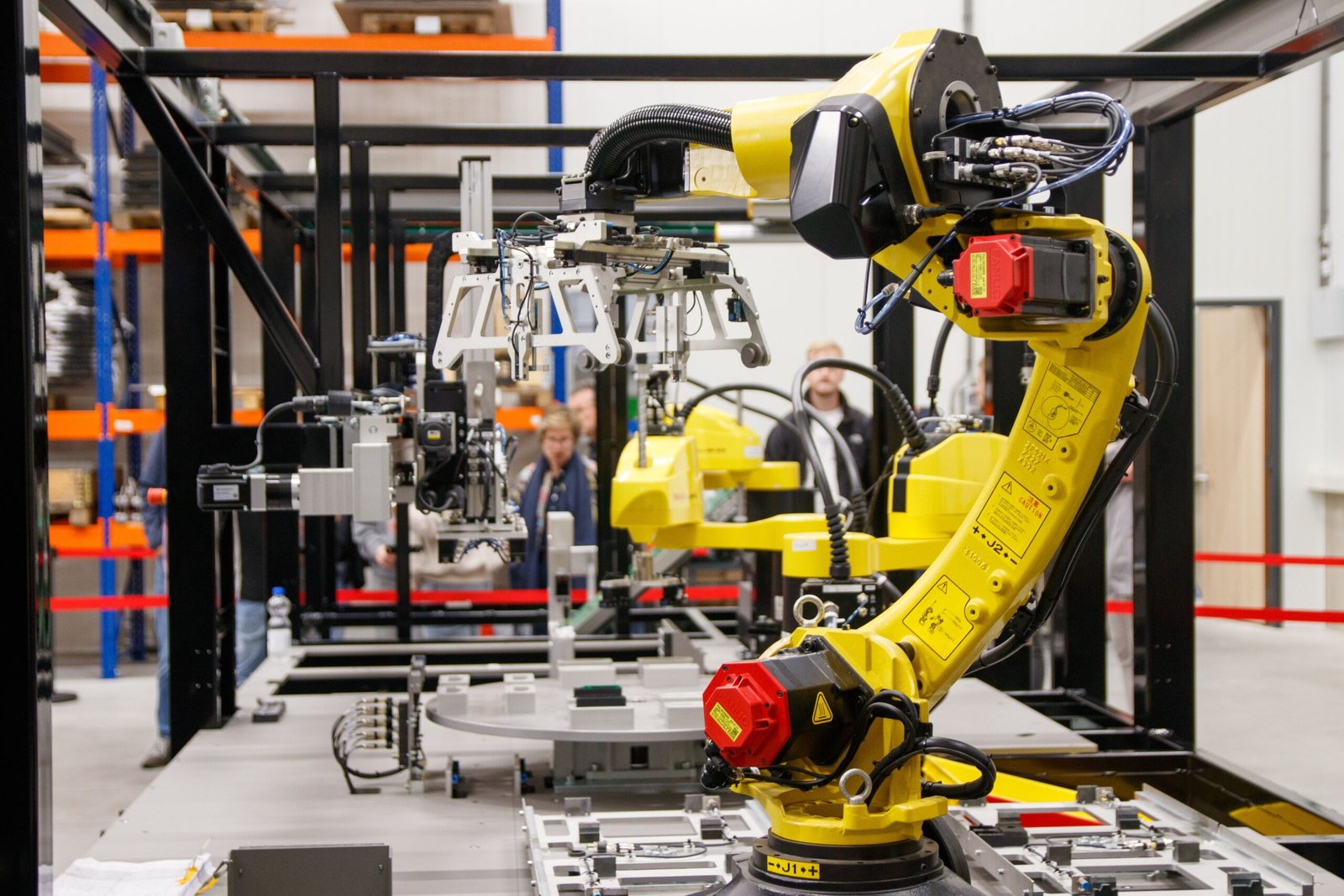
Smart factories represent the pinnacle of modern manufacturing. Driven by Artificial Intelligence (AI), Internet of Things (IoT) sensors, high-speed robotics, and automated guided vehicles (AGVs), these facilities operate at unprecedented levels of speed and efficiency. By digitizing production lines, manufacturers aim to reduce human error, optimize throughput, and achieve near-zero defect rates.
However, a surprising paradox lies at the heart of Industry 4.0: the more sophisticated and automated a factory becomes, the more vulnerable it is to its physical environment. While legacy machinery could tolerate ambient temperature swings, dusty air, and fluctuating humidity, modern automated systems rely on delicate electronic micro-tolerances. Achieving true smart factory efficiency requires maintaining rock-solid, stable production conditions on the factory floor.
1. High-Tech Sensitivity: The Paradox of Automation
Quick Answer: Automated smart factories are vastly more sensitive to ambient environmental shifts than traditional plants because high-precision optical sensors, microprocessors, and robotic arms operate on micron-level tolerances.
When human operators run manual machinery, they naturally adjust their technique to compensate for minor environmental variations—such as a slippery material, a slightly warped sheet of cardboard, or ambient glare. Automated systems, by contrast, execute pre-programmed instructions based on rigid sensory inputs.
If ambient factory conditions fluctuate:
- Optical Sensors Misread Data: Dust, fog, or high humidity can scatter laser beams and camera lenses on automated inspection lines.
- Microprocessors Overheat: Uncontrolled thermal spikes cause server cabinets and robotic drive controllers to throttle processing speed or shut down entirely.
- Robotic Arms Drift: Temperature swings cause metal structural beams and robotic axes to expand or contract, corrupting sub-millimeter positioning accuracy.
Implementing comprehensive smart factory environmental control ensures that high-tech assets operate within their optimal design parameters.
2. Sensor Integrity and Calibration Drift
Quick Answer: Environmental instability causes rapid sensor drift, leading to false-positive quality rejects, unexpected line stoppages, and frequent manual recalibration cycles.
An Industry 4.0 facility is only as intelligent as the data collected by its IoT sensor network. Thousands of vibration, optical, thermal, and proximity sensors stream real-time telemetry to central analytics engines.
When environmental conditions fluctuate unpredictably, sensor accuracy degrades. For example, sudden temperature changes alter the resistance values of electronic sensors, while airborne dust coats optical vision lenses. This causes Industry 4.0 sensor calibration to drift rapidly away from baseline values. As a result, AI analytics software receives corrupted data, leading to false-positive component rejections or triggering unnecessary emergency machine shutdowns.
3. Controlling Static Electricity and Electrostatic Discharge (ESD)
Quick Answer: Dry indoor air generates static charges on moving machinery, causing microchip damage, component sticking, and severe automated handling jams.
Static electricity is one of the most destructive hidden forces on an automated production floor. When ambient relative humidity (RH) drops below 40%, friction between moving plastic belts, electronic components, and packaging films generates high-voltage static charges.
Uncontrolled electrostatic discharge in automated manufacturing leads to two major failure modes:
- Component Destruction: Invisible static discharges strike sensitive microcircuits on surface-mount technology (SMT) lines, burning out microchips before products are even fully assembled.
- Material Clinging: Lightweight materials like plastic films, paperboard, and pharmaceutical blisters stick to feed trays and robotic grippers, causing frequent conveyor jams.
4. Regulating Moisture for Material and Mechanical Stability
Quick Answer: Integrating in-duct high-pressure humidification into factory HVAC systems keeps relative humidity stable between 40% and 60%, eliminating static and preventing material warping.
Maintaining a balanced indoor microclimate requires managing more than just air temperature; atmospheric moisture control is equally critical. Hygroscopic materials—such as wood, paper, textiles, composite polymers, and specialized films—absorb and release moisture based on surrounding air conditions. In dry environments, paperboard shrinks, plastic films become brittle, and wooden components warp out of tolerance.
To prevent these material transformations, smart facilities regulate indoor moisture levels continuously. Integrating high-capacity commercial humidification directly into main HVAC ductwork maintains optimal relative humidity (40% to 60% RH) across large production halls. This eliminates static electricity, prevents material distortion, and protects delicate electronic assemblies without leaving wet residue on machinery.
5. Thermal Drift and Sub-Micron Machining Tolerances
Quick Answer: Uncontrolled ambient room temperatures cause thermal expansion in CNC spindles, metal alloys, and measuring tools, introducing dimensional errors in high-precision parts.
In precision sectors like aerospace, medical device fabrication, and semiconductor manufacturing, parts are produced to sub-micron tolerances. Metal alloys expand when heated and contract when cooled in accordance with their thermal expansion coefficients.
If a machine shop’s ambient temperature fluctuates by just a few degrees between morning and afternoon, a CNC milling machine’s bed and spindle will expand. A part machined at 8:00 AM may not match the precise dimensions of the exact same part machined at 2:00 PM. Maintaining strict room temperature stability eliminates thermal drift and keeps high-tolerance production predictable.
6. Myth vs. Fact: Smart Factory Environments
Clearing up common misconceptions helps plant managers optimize their facility conditions:
| Misconception | Manufacturing Reality |
| “AI software can automatically compensate for physical environmental shifts.” | Software algorithms can adjust parameters slightly, but physical material warping or fried microchips require physical intervention. |
| “Standard air conditioning provides enough environmental control for smart lines.” | HVAC cooling strips moisture from the air; without active humidification, low humidity causes severe static electricity build-up. |
| “Enclosed robotic cells are immune to plant floor conditions.” | Unless a cell is a certified clean room, ambient air, dust, and humidity continuously circulate through safety mesh and cable ports. |
7. Smart Factory Environmental Readiness Checklist
Use this practical audit list to evaluate environmental stability on your plant floor:
- [ ] Continuous RH Tracking: Are digital hygrometers installed near high-speed automated lines to verify 40%–60% relative humidity?
- [ ] ESD Grounding Audit: Are conveyor belts, robotic grippers, and feeder trays tested routinely for static charge accumulation?
- [ ] HVAC Integration: Is high-pressure humidification installed in the main air handlers to maintain uniform moisture distribution?
- [ ] Thermal Mapping: Are thermal sensors positioned at machine-bed levels to detect localized heat pockets from heavy drives?
- [ ] Filtration Checks: Are positive-pressure air filtration units operating effectively to keep fine dust off optical vision lenses?
The true potential of a smart factory is realized only when digital intelligence is paired with physical environmental stability. Advanced robotics, AI vision systems, and ultra-precise automated lines require a controlled atmosphere to perform at their peak. By regulating room temperatures, controlling air purity, and deploying precise commercial humidification to eliminate static and material warping, manufacturers protect their high-tech investments and ensure reliable, zero-defect production.

The Ultimate Master Guide to Choosing the Right Collapsible Rigid Boxes

How Garden Maintenance Improves Croydon Properties’ Value

How to Get Your Oven Sparkling Clean Without the Hassle

How Collapsible Rigid Boxes Combine Luxury, Convenience, and Cost Savings

Lab-Grown Vs Natural Diamonds Engagement Rings

Who Is Indiana Urban? Inside the Life of Karl Urban’s Son and Rising Actor

Jennifer Seyfried: All About Amanda Seyfried’s Sister, Her Life and Career

Who Is Zachary Hudson? Inside the Private Life of Cindy Williams’ Son

Who Is Stephen G. Walker? All About PinkPantheress’ Father and His Academic Career

Cynthia Womack Biography: The Life, Career, and Legacy of Connie Britton’s Twin Sister
Who Is Indiana Urban? Inside the Life of Karl Urban’s Son and Rising Actor
Jennifer Seyfried: All About Amanda Seyfried’s Sister, Her Life and Career
Who Is Zachary Hudson? Inside the Private Life of Cindy Williams’ Son
Who Is Stephen G. Walker? All About PinkPantheress’ Father and His Academic Career
Cynthia Womack Biography: The Life, Career, and Legacy of Connie Britton’s Twin Sister
-
Biography7 months ago
Who Is Indiana Urban? Inside the Life of Karl Urban’s Son and Rising Actor
-
Biography7 months ago
Jennifer Seyfried: All About Amanda Seyfried’s Sister, Her Life and Career
-
Biography7 months ago
Who Is Zachary Hudson? Inside the Private Life of Cindy Williams’ Son
-
 Biography6 months ago
Who Is Stephen G. Walker? All About PinkPantheress’ Father and His Academic Career
-
Biography7 months ago
Cynthia Womack Biography: The Life, Career, and Legacy of Connie Britton’s Twin Sister
-
 Biography6 months ago
Who is Lynn Levesque? Everything to Know About Triple H’s Sister
-
 Biography8 months ago
Who Was Gretchen Knauff? The Private Life of Jennifer Coolidge’s Mother
-
 Biography6 months ago
Lynn Payne: Inside the Life and Love Story of Randy Savage’s Wife